

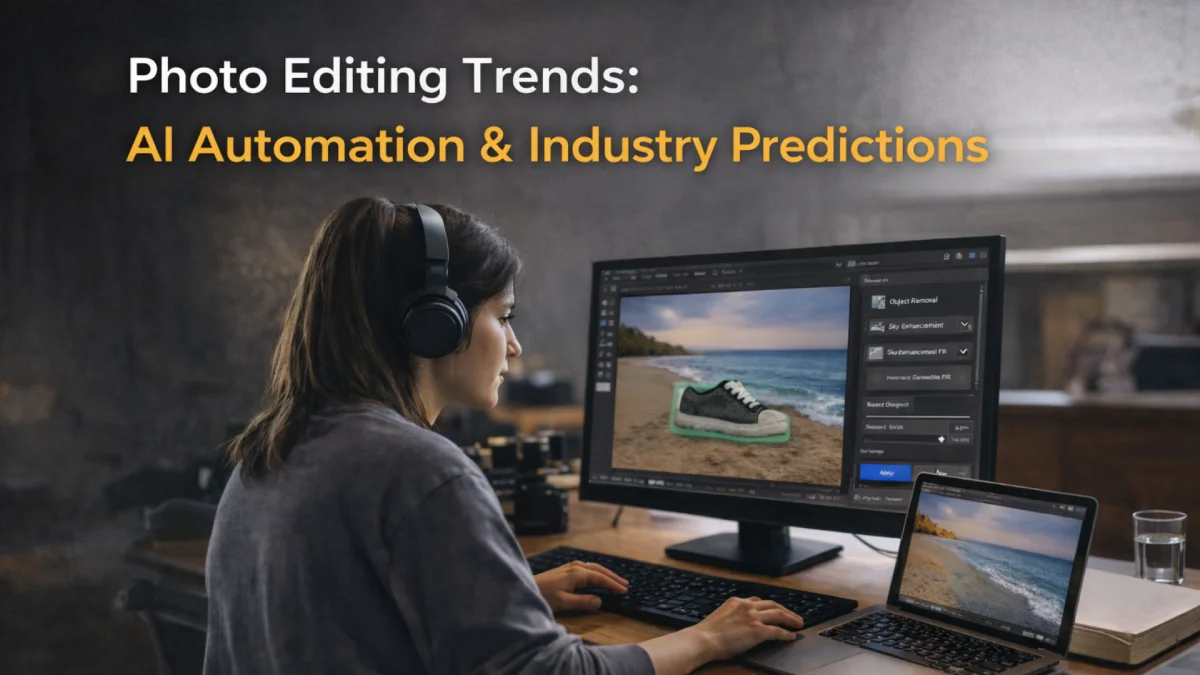
You’ll be shocked to know that, according to global market analysis, the photo editing software market is valued at around USD 1.19 billion in 2026.
In the future, photo editing will include newer features for basic editing, including masking and removal of objects. Such automated processes can inspire photo creators to become more experimental. The automation of AI leaves more room for photo editors to refine their ideas and storytelling skills.
The latest photo editing services and trends will combine AI tools with fast, creative thinking, and good judgment. It sits where innovation, technology, and human creativity meet, where AI helps enhance storytelling, and not replace it.
What Changed in Photo Editing in 2026
In 2026, Photo editing has undergone some major changes in different industries. It has mostly been driven by AI integration with fast workflows. Once, when a photo used to take almost a day or more to edit, AI has made it easy through automation.
- AI has become an important part of photo editing, and it now operates most of the work automatically.
- Conversational and prompt-based editing lets users describe changes instead of making them manually.
- Firefly and other advanced creative AI tools make it possible to remove, expand, and restore objects in a high-quality way.
- On-device processing makes updating faster, more accurate, and possible in real time.
- Software environments are smarter now that they have AI masking, auto-retouching, and workflows.
- Editing is significantly faster and more scalable, especially for high-volume projects.
- Strong shift toward natural, authentic, and minimal visual styles.
- Digital platforms are also seeing a rise in bright, high-contrast, and experimental images.
- More attention is paid to images that tell stories, evoke emotions, and reflect identity.
- Hybrid workflows blend the speed and creativity of AI with human oversight.
- Ethics, openness, and accurate portrayals have become more important.
- The time it takes to go from thought to action has shrunk, which has made editing easier to understand and use.
Latest Photo Editing Trends 2026
In 2026, photo editing has shifted from too much editing to raw, authentic, and nostalgic aesthetics. Key trends that have made their way are style grain, muted matte colors, and AI-automation for lighting.
Here are the top photo editing trends that are ruling the marketplace:
AI with Automation
AI has accelerated the major part of the editing work by automating. It has made it easier to automate repetitive functions. It can be used for extracting an object from an image, inserting/masking, noise reduction, and batch processing.
Adobe Firefly, Luminar, and Capture One Pro automate repetitive processes. Device processing and language-based editing allow for quick and easy editing on desktop, tablet, and mobile.
Raw Aesthetics
Natural and unedited editing has become a new photo trend across all industries. Textures, minor imperfections, and real skin tones are becoming more common. Professionals nowadays focus on editing to a limit, and the extensive edit is to be avoided.
Dreamy, human-focused storytelling is enhanced using soft haze and tone curves, creating warmth while avoiding a cold, overly polished look.
Analog Film Inspirations
Aesthetic edits leave the base edits unchanged. Film grain, heavy grain, nostalgic tones of the 70's and 80's, layers, and soft light leaks are now common in contemporary editing. Elements like depth and motion blur are commonplace in contemporary storytelling.
On the other hand, fine shadows and other quality elements are integral. The main goal is to enhance reality rather than transform it.
Matte and Muted Color Grading
The latest edit trends have now started to shift from the hyper digital and ultra-low contrast edits. Precise grading, overbalance, soft cinematic lighting, warm neutrals, and other classic and natural edits. Textures and other real-life elements are added to create an organic feel.
Organic and Fluid Designs
Rather than straight, sharp edges and rigid forms, there are more smooth transitions in the trends. It follows the forms and compositions inspired by nature. This further aids in human connection and emphasizes the warm, hand-crafted feel of the visuals.
Stylistic and Experimental Directions
The hallmarks of editorial and social media content include a cinematic narrative, dreamlike color palettes, bright, bold neon's, and free-form experimentation.
Brand visual systems provide the necessary cohesion of tone and style continuity across multiple campaigns, while long exposure and motion blur add life and narrative depth.
Top AI Photo Editing Tools & Features
AI-powered photo editing tools have become essential in professional workflows.
AI tools have made post-production faster and easier. Professionals can focus on telling stories, making photos look good, and handling large amounts of work because of AI nowadays.
The top AI photo editing tools are:
| Tools | Used For | Key Features and Strengths |
| Adobe Photoshop | Professional Editing | Generative Fill & Expand (adding/removing objects), Neural Filters (improving face features), AI-powered masking and selection, high-precision retouching, and Firefly AI integration |
| Adobe Lightroom Classic | Batch & File Management | AI-assisted filtering, Lens Blur, Background/Object Removal, and batch-apply presets and styles across multiple images |
| Luminar Neo | Landscape & Creative Edits | AI Sky Replacement, Relight AI, Light Depth, Enhance AI, Face & Skin AI, Upscale & Restoration, and cloud sync for lighting |
| Canva Magic Studio | Quick Social Media Designs | Magic Edit, Magic Eraser, background removal, template-based AI editing |
| Photoroom | Mobile & E-commerce | Instantly remove backgrounds, improve product photos, and make batch changes on mobile devices first |
| Evoto AI | High-volume Portraits | Automated portrait retouching, skin/face corrections, and color consistency across large batches |
| Fotor | Free / Quick Fixes | One-tap enhancement, AI clothes/hair changer, background replacement |
| Aftershoot | Event & Wedding Photography | AI culling, pre-edited gallery creation, style learning, and batch replication |
| Imagen AI | Portrait & Weddings | Lightroom-integrated style replication, consistent skin tone edits across batches |
| Topaz Photo AI | Restoration & Technical Enhancement | AI denoise, upscaling, sharpening, archival restoration, Autopilot suggestions |
How Photo Editors Must Adapt in 2026
Successful editors don't fight AI or trust it with their judgment; they have just adapted it to the trends. People who have positioned themselves at the intersection of human ingenuity and AI efficiency are the ones who are aware that their profession is evolving.
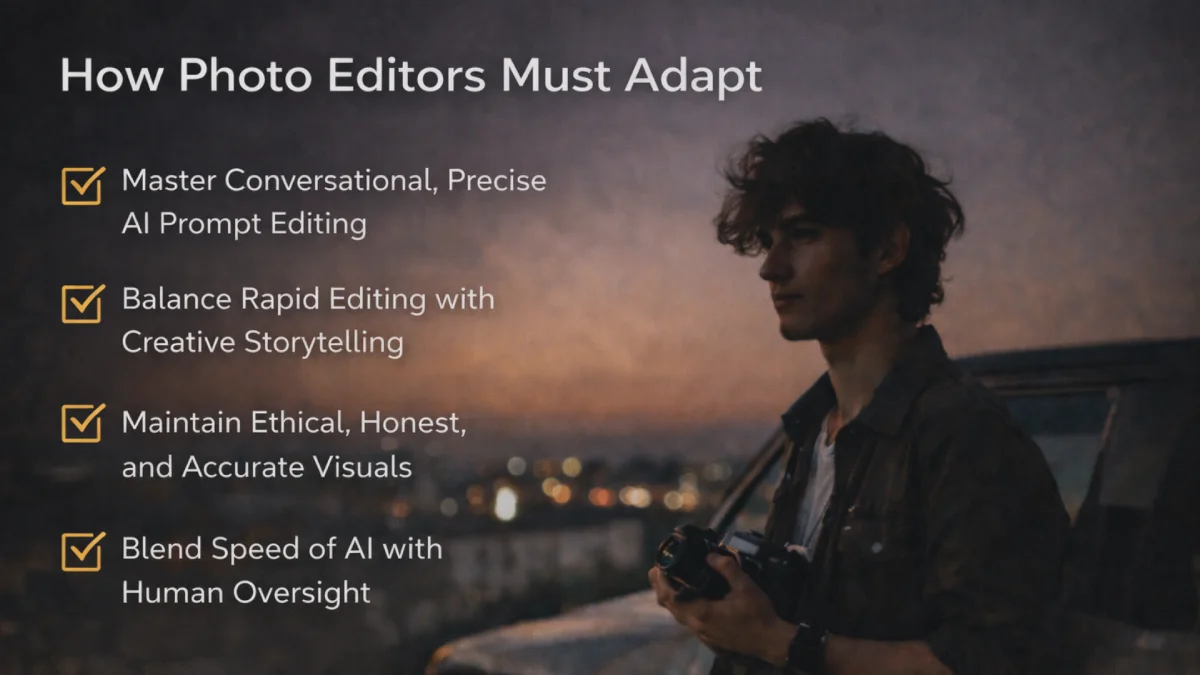
In 2026, this is how the role of a photo editor is rapidly evolving.
From Technical Execution to Creative Direction
Standing out from the crowd used to require proficiency in technology. The bulk of the work done repeatedly in a Photoshop workflow is now done by AI. The use of these AI tools and seamless execution has become the expected industry standard across the board. Also, the ability to use them has given them a clear edge in the industry.
The most technically advanced editors are the ones that tend to be the least creative. Their choices shape the tone, form, narrative, and emotional impact of the work. They primarily focus on the development of the narrative, the fusion of different narratives, and the selection of AI outputs.
For commercial, portrait, or wedding work, this often means taking on a directing role and setting the style to meet the client's preferences. The highest demand in 2026 will be for editors who synthesize great technical and creative self-regulation in balance.
Developing Taste & Artistic Vision
Professional photo editors must have a finely developed sense of taste. It is absorbed and developed by extended contact with exceptional work. The development of taste is similar to the construction of a mental reservoir that is built through contact with knowledge.
AI can quickly and easily replicate work. But to develop personal taste and artistic skill, individuals must put in consistent effort. This comes from critical reflection and focused thinking to refine their results.
True Taste defies copying and trends. It means you can create whatever makes you feel or look good and makes sense to you. Rather than doing some automated editing, the good ones make sure the AI edits are aligned with the storyline, the tone, and the client’s objectives.
Building Your Unique Visual Style
Consistency is what makes individual styles unique. It shows individuality through unique perspectives across different lighting and environments. AI tools can create copies, mixing and matching small variations, but the only work that can't be AI-generated is work that is obviously yours.
Developing a unique style takes experimenting with different colors, contrast, textures, and editing techniques. It comes down to choosing what works best and repeating it consistently.
The more an editor practices, the more their style becomes apparent. For editors, this means keeping an archive of their work may benefit them more than others, especially when AI becomes the norm for editing. An editor must combine their own unique voice styling with AI techniques and be themselves the most.
Industry Predictions & Job Market Impact
Research shows that the approximate growth of photo editing could surpass 15 billion by 2028. In 2026, the editing industry is not only facing automation issues but also structural transformation.
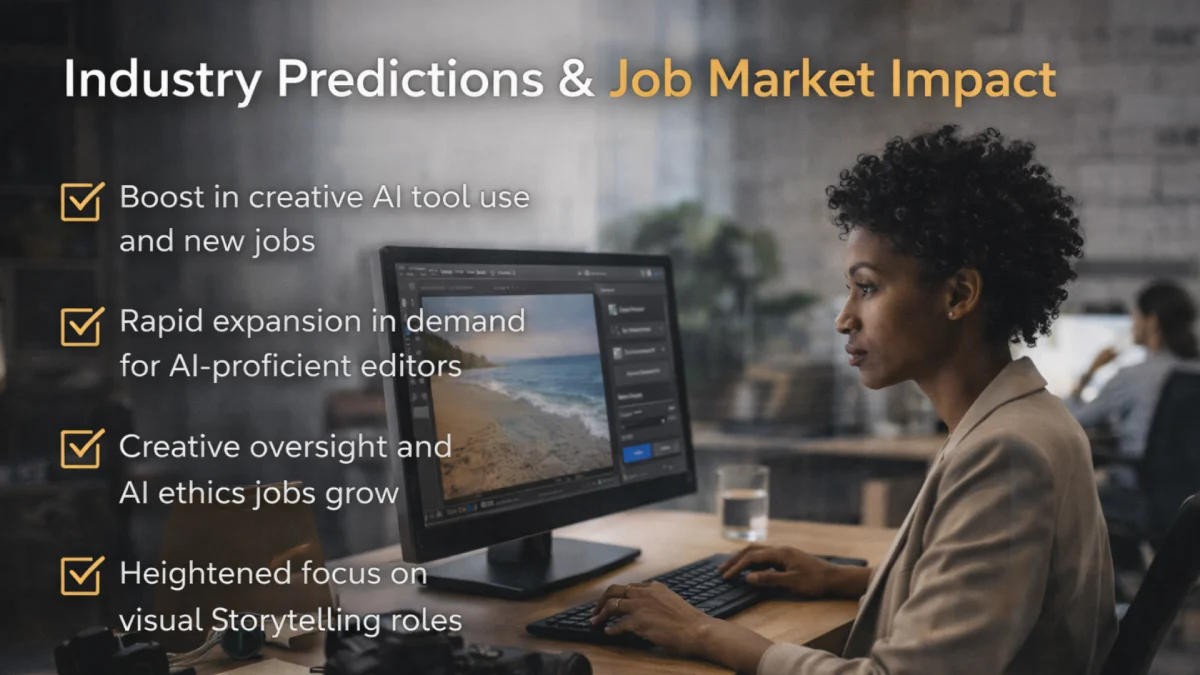
Industry Predictions and Trends
Artificial intelligence is being integrated with editing tools. It is also expected that AI will be integrated into all editing tools, varying from simple to complex tools, in the years 2026-2030.
In upcoming years, it is expected that companies will be pushed to create more user-friendly, on-the-go apps. Due to the rapid rise in smartphone usage, it is projected that non-professional users will increase. As camera quality increases and people begin to take more pictures, the need for 3D, AR, and HD photo editing tools will also rise.
Cloud editing will help shorten digital editing workflows to increase the ethical and sustainable use of editing. It will also improve the privacy of users' data and the responsible use of artificial intelligence.
Job Market Impact
The rise of AI is continuously reshaping the job market in several ways, including:
Automation of Routine Tasks
AI photo editing apps allow basic editing to be done automatically; it's not going to require another person's involvement. Basic editing, like color work correcting, removing backgrounds, or even just doing touchups, will all be done by AI.
There is work to be done as a human editor, but AI is going to do the basics. Creative editing is going to be human work moving forward, and that is when humans are really going to be able to decide what to do with the work.
Shift in Skill Requirements
As the technical work is going to shift to AI in editing, compensating for editing skill is going to be less manual editing and going to be more incorporating AI. AI allows editors to manage and edit large batches of images at scale.
With ongoing advancements, it also supports intelligent enhancements and context-based editing. It is going to take a lot of judgment and human creativity, but the role of the editor is going to change with the use of more strategy.
Increased Demand in E-commerce & Social Media
With the expansion of social media and online markets comes the need for mass picture editing. Businesses want product pictures for online stores and want to advertise on social media. Mass photo editing, particularly in the Asia Pacific region, is one of the fastest-growing markets for employment opportunities.
Companies now offer AI-powered editing tools that help photo editors process thousands of images each week. These tools ensure high-quality, brand-consistent visuals that resonate with the target audience.
Strategic and Supervisory Opportunities
New supervisory and strategic job opportunities arise for photo editors. Even as AI takes over typical editing jobs, there is still a need for human management. To ensure that workflows are in line with company expectations and quality, professionals are continuously adapting with AI.
These professionals are responsible for brand consistency over long-term campaigns and across different platforms. These positions are primarily focused on AI as a function, rather than direct manual roles. Compared to the classical assembly lines, human involvement is determined to be far more significant, and human presence is not required.
Ethical Concerns & Authenticity Challenges
Rapid usage of artificial intelligence in photography blurred the border between documented reality and digital creation. AI-edited images can change natural textures, create real sceneries, or manipulate human beings, questioning the meaning of photography.
Detecting AI-Edited Photos
Even while AI generators are getting better and better, there are still a lot of things that need to be found with the right kind of techniques. Some of the common signs are extra fingers, limbs that don't look right, and faces that aren't symmetrical. This also includes skin that is too smooth, shadows that don't make sense, or features that don't match up.
Usually, the logos, patterns, or text that don't make sense are also typical signs of AI activity. Most of the time, the dependability is provided by source verification, which involves forward image searches, metadata analysis, and source tracing.
As AI detection and provenance will include embedding verification, C2PA is a good guide for possible detection and provenance. Experts suggest watermarking unedited originals, retaining editable histories, and helping trust, validating outputs.
Copyright & Training Data Issues
There are several ethical and legal questions that arise from AI-generated pictures. Generative AI models are typically developed using huge databases of photos. These are usually taken without the permission of the artists, subjects, or photographers involved.
This action caused cases and moral discussions about copyright violations, authorship, and commercial use. If an AI-generated image substantially replicates a copyrighted work or imitates an artist's manner, it can be considered a violation.
Artificial intelligence (AI)-only works are in legal uncertainty because copyright protection in most states requires human authorship. Another issue is the potential for AI to spread false information and perpetuate damaging stereotypes, which could compromise the credibility of the media.
Professional Standards & Best Practices
In the year 2026, professional standards place a strong focus on hybrid workflows that merge the efficacy of AI with the ethical supervision of humans.
Key considerations include:
- Ethical concerns around consent, bias, and authenticity in AI-edited photos.
- Detection of AI edits using visual anomalies, forensic tools, and provenance checks.
- Copyright and training data issues, including unauthorized image use and ambiguous authorship.
- Hybrid workflows emphasize human oversight, transparency, and content authenticity standards.
- Clear retouching scope, disclosure, and reference standards with clients.
- Building trust and credibility through documentation and ethical practices.
Action Steps
In the year 2026, the industry will have several new and interesting tool sets when you factor in the use of AI, human creativity, and human conscience. AI has improved the photo editor's workflow. It can take care of the more repetitive tasks, as well as take care of Batch processes at lightning speed.
Even providing the ability to edit a set of photos via a prompt or conversational edit. Providing the professional with the ability to broaden visual storytelling and confidence in creating and developing unique styles. AI does provide great assistance and improvements to the workflow. It also raises a lot of ethical, copyright, and authenticity issues.
Innovation is key for the next generation of photo editors. In the future, the top editors will combine AI, speed, creativity, and ethical considerations. Professionals will define the industry, simplifying complex workflows while preserving the essence of visual storytelling.
Frequently Asked Questions
Will AI Replace Photo Editors by 2026?
To be honest, the answer is NO. Photo editing in 2026 has already seen several major developments in various fields. These changes have been predominantly fueled by the integration of computer-based editing into various industries. Tasks that used to take days or weeks to complete have been streamlined using computer-based editing as a form of automation.
What Skills Do Photo Editors Need in 2026?
In 2026, professionals will need both technical and creative skills. This includes proficiency with AI tools, creative direction, visual storytelling, ethical awareness, and hybrid workflow management.
What Are the Best AI Photo Editing Tools in 2026?
Best AI photo editing tools in 2026 so far are Firefly, Photoshop Generative Fill, Midjourney, DALL.E 3, and specialized AI masking or AI culling software.
How Much Faster Can AI Make Photo Editing?
AI can reduce manual retouching time by 96% and speed up batch workflows of editors, depending on its complexity.
Is AI Photo Editing Ethical? What About Copyright?
Ethical use requires transparency, disclosure, and adherence to content provenance standards; copyright risks depend on training data and human authorship.
Can I Use AI Photo Editing for E-Commerce & Real Estate?
The answer is Yes. AI accelerates high-volume edits, ensures consistency, and supports realistic, appealing visuals for marketing and listings.
What's the ROI of Switching to AI Photo Editing?
Faster turnaround, lower labor costs for routine tasks, higher-quality outputs, and improved conversions in e-commerce and real estate.
What Photo Editing Trends Should I Expect Beyond 2026?
Beyond 2026, photo editing will become faster and more AI-driven. It is expected that AI will handle the repetitive tasks, and editors will focus on creativity. Tools are also going to be user-friendly and totally capable of prompt-based editing.