

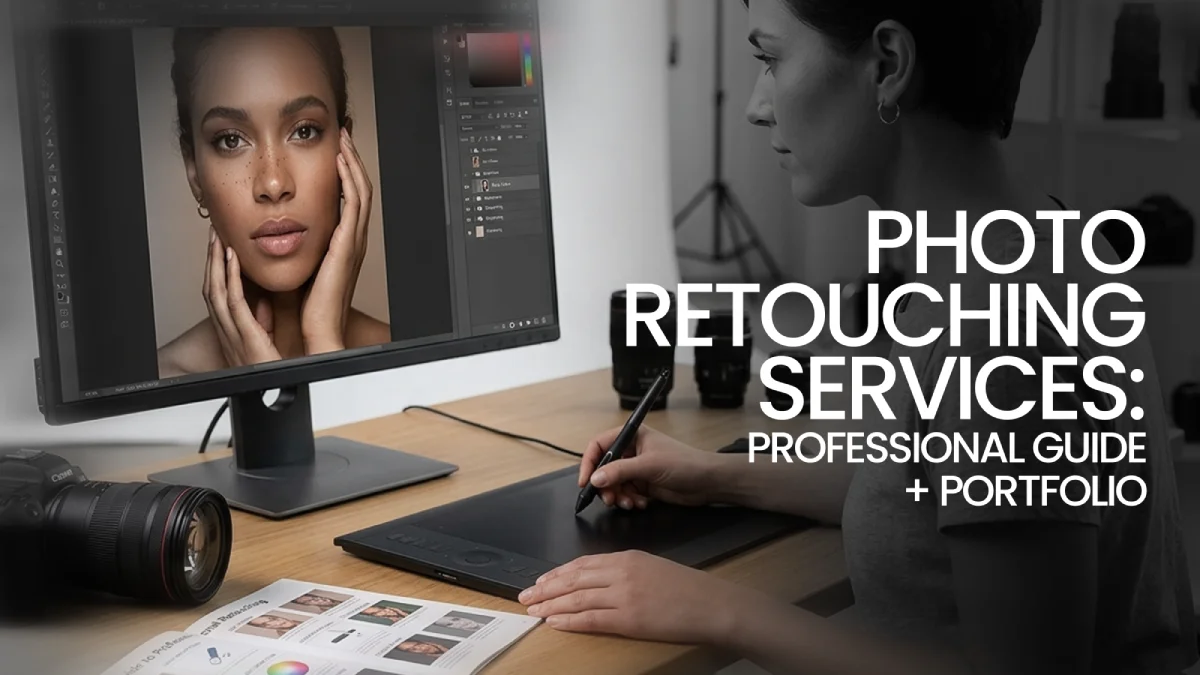
The quality of the images defines how your brand is outstanding. It has become essential for capturing attention in every type of industry. Strong, well-retouched images are no longer optional. They are important for grabbing attention, building trust, and increasing sales in many industries.
This article provides a complete guide to professional photo retouching in 2026. It covers everything you need to know, including how the process works, pricing structures, service types, and how to choose the right photo retouching partner for your needs. You'll also explore industry-specific workflows, best practices, tools, and the latest trends shaping the future of image editing.
Whether you are a business owner, photographer, or creative professional, this guide will help you make informed decisions and achieve consistent, high-quality visual results.
What is Photo Retouching & Why It Matters
Photo retouching is an entire process that is used to make an image better. It involves precise, advanced adjustments such as skin smoothing, blemish removal, background cleanup, detail enhancement, and exposure correction. High-quality editing of portraits, product photos, and architectural visuals often requires professional tools like Adobe Photoshop. Eventually it:
- Boosts Engagement: The presence of high-quality edited images in e-commerce, marketing, and client presentations makes the content more attractive, engaging, and professional.
- Influences Purchase Decisions: Research shows that 75% of online shoppers consider images of products offered to them during the buying process important.
- Saves Time and money: Retouching saves countless hours and expenses associated with re-shoots due to minor details such as varying light levels, and also saves time.
- Assists in Architectural Visualization: For designers as well as architects, retouching assists in creating photorealistic images that portray the design with high accuracy, thereby aiding in trust building with the client.
In-House vs Outsourcing Photo Retouching
With in-house photo retouching, internal teams will have better control and alignment with the brand. With outsourcing, photo retouching tasks become scalable and specialized editing services.
The most viable option will depend on the volume of work, the budget, and the specifics of the project.
| Aspect | In-House | Outsourcing |
| Cost | High fixed costs (team + tools like Adobe Photoshop) | Lower, pay-per-project |
| Control | Full control, quick revisions | Limited, depends on communication |
| Expertise | Limited to team skills | Access to specialists |
| Scalability | Hard to scale quickly | Easy for large volumes |
| Turnaround | Fast for small tasks | Faster for bulk work |
| Consistency | High (internal files) | Requires trust/NDAs |
Photo Retouching Pricing: How Much Does It Really Cost?
When it comes to pricing for photo retouching, there are various aspects to take into consideration. If you're aware, it will help you make a more astute choice and give you an understanding of what will be best for your budget.
Here is an explanation for each one:
- Pricing ranges from under $1 to $100+ per image: The cost is related to project type, project complexity, and the experience and skill of the service provider. A simple product photography project would be more inexpensive compared to high-end advertising photography.
- Basic edits (color, exposure) are the most affordable: Less expensive offerings would include adjustments to brightness and contrast, color additions, and minor removals of unwanted objects within an image. These changes require less time and effort and, therefore, less skill, so the expense is reduced.
- Advanced retouching (beauty, compositing) costs significantly more: Skilled and time-intensive services such as skin retouching and object removal or background edits, and advanced image compositing are very high-cost and in-demand services.
- Bulk volume reduces per-image pricing: For bigger projects, like e-commerce catalog photos or real estate photography catalogs, there's always an offer of discounts. For example, while a batch of 10 photos might be priced at $5 per photo, a batch of 500 photos will be priced at only $1 or $2 per photo.
- Rush delivery adds 25-50% to the total cost: Expedited timelines require additional resources or prioritization, which increases pricing. Standard delivery (24-48 hours) is usually included in base rates.
- Providers in South Asia offer more competitive rates: Due to lower operational costs in their countries, high-quality image retouching is offered at much lower prices in comparison to countries in the USA and EU, such as India, Bangladesh, and Philippines.
- Agencies provide better consistency and scalability: While brand consistency and quality control can be maintained by larger retouching agencies, they can also deal with larger quantities of requests.
How to Choose a Professional Photo Retouching Service
Your best option is to find a service provider that meets your requirements. Keep the cost as a secondary option.
Here is some key information to keep in mind while choosing a professional photo retouching service:
- Proof Over Promises: Instead of paying attention to the look of a website, focus on the portfolio. Most companies highlight only their best work, not their shortcomings. Check for systematic, evidence-based retouching, with proper color correction and attention to detail specific to your industry.
- Real Testing: Before committing, request a paid sample of 3 to 5 images to evaluate whether the editing style, subjects, and lighting are compatible with your requirements.
- Secondary over Tertiary: Retouching and skin editing should appear natural and consistent, not overly blended or excessively processed. Over-layered shadowing is a key issue to watch for, as it can reduce realism.
- Price Evaluating: Keep in mind that value is captured through quality and results. As in most markets, higher-quality output often justifies the cost, making it necessary to evaluate pricing carefully rather than focusing only on the lowest rate.
- Speed and Evidence: Check the average turnaround time through reviews. Ensure there is sufficient customer feedback to understand how quickly and reliably the provider delivers.
- Scalability Evidence: Consider whether the provider can maintain the same quality across both small batches and high-volume projects, ensuring consistency in output.
- Secure Technology: Check how they guarantee the protection of your data, including the use of NDAs and measures to safeguard sensitive or proprietary information.
- Data Protection: Ensure they clearly define how your sensitive and proprietary data is protected, and how overall information security is maintained.
Photo Retouching Process & Best Practices
Achieving better results in retouching is not a matter of chance. Every image involves a systematic process that successfully combines the structure of a workflow with the artistry of a creative vision.
Whether the retouching takes place in-house or is done externally, knowing the workflow offers the advantage of quicker, consistent, quality results, especially in e-commerce, portraits, or architectural visualization.
The Photo Retouching Process:
1. Image Culling
The first stage of this process consists of analyzing and picking the most prominent photos presented in the group set. This stage involves removing duplicates, reducing the number of out-of-focus and out-of-bounds exposures that cannot be worked on, and correcting exposure.
Finally, photos that provide the most value in this editing process are identified, and the focus shifts to repairing these photos.
2. Global Edits
Now that the best images are ready to go, some global edits are performed to provide them with an equal and fair starting level of exposure and contrast.
Shadows, color brightness, saturation, and overall color balance are then adjusted to ensure consistency across the set.
These global edits are performed in mass edits in order to provide the images with the necessary level of consistency they require before further edits. These edits are almost always done using Adobe Lightroom.
3. Local Edits
Now, with the global edits done, the photos are ready to receive some Adobe Photoshop edits. These edits are mostly perfection edits; edits performed to the photos to ensure not only the sufficiency of the image but also to provide the images with some consistency that these images require.
Some of the edits are out of bounds, and some images cannot be worked on due to these same constraints. Overall, local edits are performed to provide images with the level of perfection they require without editing the images to the point of reducing their overall quality.
4. Specific Detailed Retouching
In this instance, re-touching is customized based on the content of the image. In portrait photographs, the skin is refined, the eyes are embellished, and the hair is fine-tuned, while looking as if nothing has been changed.
In photos of products, dust is removed, reflections are altered, edges are sharpened, and colors are adjusted. In photos of real estate, the sky can be altered, the image can be perspective changed, and distracting items can be removed.
5. Creative Grading and Finishing
In this consideration, the overall look and feel of the image is configured. Here, advanced color grading, and tonal manipulation are applied. In this case, the vignetting is polished, and the adjustments of sharpening and noise are refined. In general, the image quality is the same.
6. Final Quality Control Inspection and Export
Before production and delivery, all images undergo quality checks to ensure a consistent look and feel, as well as the same resolution, file type, and color profiles. The final inspection is done to ensure the images are to the desired standard before they are exported and sent to the customer.
Best Practices for Professional Results
- Work with layers and smart objects so you can make edits without having to start over from the original image.
- Avoid overly dramatic edits, and make sure to keep edits looking as realistic as possible.
- Ensure excellent, professional-quality edits by keeping all the images within the same, unified aesthetic.
- Use accurate monitors so you can obtain true-to-life monitor colors.
- Double-check your final edits by zooming in and catching details that are easily overlooked.
- Start with the original images to keep the photo's perspective in check.
- Work within the project, whatever it is, make sure to adapt your images, be it portraits, products, or buildings.
- Your workflow and files should remain in an organized manner to eliminate high-stress revisions.
- Clear briefs with outlined styles and expected results should be prioritized.
- When images start looking overly edited, it may be better to stop retouching.
Photo Retouching Technical Specifications & File Formats
To achieve professional-quality photo retouching, it’s essential to follow the right technical specifications, workflows, and file management practices.
Key requirements include:
- Powerful hardware for large layered files
- Color-accurate, calibrated monitor
- Retouch in RGB/CMYK and 16-bit depth
- Export final files in 8-bit RGB
- Correct resolution for screen, print, and platforms
- RAW/DNG for editing, PSD/PSB for working files
- TIFF for print, JPEG/PNG/WebP for web
- Non-destructive workflow with layers and masks
- Organized file management
- Essential for e-commerce, architecture, and editorial projects
Format | Best Use | Pros | Cons |
| RAW | Initial capture | Maximum detail, full dynamic range | Large size, requires conversion |
| TIFF | Editing & archiving | Lossless, supports layers | Very large files |
| PSD (Photoshop) | Retouching workflow | Supports layers, masks, and adjustments | Proprietary, large size |
| JPEG | Final delivery | Small size, widely supported | Lossy compression, limited editing |
| PNG | Web use | Lossless, supports transparency | Not ideal for photography |
Photo Retouching by Industry: What You Need to Know
Photo retouching differs across industries; techniques, ethics, standards, and expectations vary within each one. The way you would do a luxury fashion campaign would be completely different than how you would do a documentary news photo.
Fashion & Editorial
In photo retouching, fashion, jewelry, and editorial are the most refined areas, and this area has the highest skill level required. In retouching, there is compositing of all the frames, there is frequency separation for skin, there is hair masking, clothing is smoothed, there is detailed color grading, etc.
The standard buckle is set to keep the skin or jewelry texture spectrum. The files are frequently 16-bit TIFFs, and their archives and prints are layered PSDs. There are guidelines for ethical body and skin modifications, and this frequently requires disclosures.
E-Commerce & Product Photography
Retouching is done on the basis of consistency, speed, and precision. The most common functions in this area are:
- Background removals and replacements
- Color corrections
- Removal of dust and scratches
- Addition of shadows and
- Ghost mannequin manipulations
The color accuracy is very important; it is one of the main factors behind the high rate of returns. Amazon, Shopify, and other high-volume product sites have a lot of specific technical needs that are often sent to offshore editing companies.
Portrait & Headshot Photography
The edits here focus on alterations while keeping them as natural as possible. Editing skin is done through blemish removal, skin toning, eye, teeth edits, and background changes. For high-end beauty portraits, there are changes through frequency separation and additional color changes.
Wedding Photography
Wedding photography combines high quantity with high emotional value. Global batch edits for exposure, white balance, and color grading are done, with detailed edits only on hero images. Object removal and consistent look through large galleries are done here. Unlike older trends, the modern trend favors natural and timeless looks over heavy grading.
Real estate & Architecture
The aim of real estate and architecture edits is to enhance the properties, while not lying about them. Basic retouching includes replacing the sky, window pulls, color changes, perspective adjustments, removing small objects, and making the grass greener.
Virtual staging is usually done through furnished spaces that are empty, while architectural photography requires elaborate perspective adjustments and HDR blending.
Food & Beverage
The main purpose of food and beverage photo editing is to make the picture better so that people get a clear idea of their food. The priorities of edits are the increased brightness of color, increased visibility of the texture, and the appearance of condensation or steam.
Edits on food images should exaggerate to a point that it stays truthful about the product and should not go beyond that. For beverage images, focus is on the clarity of the liquid, foam, bubbles, and light effects.
Medical and Scientific
Medical and scientific imaging involves some of the strictest ethical standards. The same type of change is applied to every instance of something, increasing the brightness of an image to make every detail bright. No data manipulation or alteration is allowed.
In promotional uses of scientific and medical imaging, accuracy and professionalism are applied to standard retouching practices.
Journalism and Photojournalism
Journalism and photojournalism retouching is generally prohibited. Minimal adjustments like exposure, contrast, conversion to black-and-white, and cropping are allowed. Adding or removing any details or elements is considered to violate journalistic integrity and may lead to disqualification or professional repercussions.
Photo Retouching Trends for 2026
In 2026, the photo retouching industry has reached its peak level of innovation. With the implementation of Artificial Intelligence and the increasing innovation in the application of AI, the market for photo retouching is continuing to grow.
Key trends that are going to be impacting the industry:
AI Photo Retouching and the New Norm
AI is becoming integrated into everyday retouching workflows for removing backgrounds, cleaning up objects, and making simple skin edits. Editors can now spend their time on higher-level creative and more time-intensive edits.
The use of Adobe Firefly, Photoshop Neural Filters, and Luminar Neo is becoming more commonplace, providing speed, efficiency, and scalability like never before.
AI in Marketing
Body-modifying edits in ads are banned in Norway, the UK, France, Australia, and other countries, and are forcing brands into more ethical editing.
Brands are now focusing on the processes and principles of responsible editing and transparency, and in some cases, establishing strong internal controls over the extent of image manipulation that is permitted. Trust and brand reputation can be enhanced through responsible editing.
Film-Inspired and Subtle Aesthetics
Warm tones, soft contrast, and a focus on the story are becoming more prominent in editorial, fashion, and lifestyle photography.
In film-inspired and subtle aesthetics, trends are leaning towards minimalism, through clean compositions, accurate colors, and naturally cast shadows for a refined and authentic showcase.
Bold Colors and Experimental Looks
As some companies are continuing to build their business on subtle designs, others are attempting bolder and more imaginative designs.
Fashion, e-commerce, and conceptual photography are presenting more of the attention-grabbing designs that can look surreal, and use strong contrasting and neon color palettes. This experimentation creates a distinct look from their competitors in the digital marketplace.
Merging of CGI Photography
The blending of CGI and photography is becoming a trend, especially in depicting luxury products. Using hybrid approaches, photographers can control the lighting, materials, and the scene.
With the use of generative AI, photographers can create a multitude of variations for backgrounds, products, and lighting without needing to re-shoot.
Hyper Personalization at Scale
Artificial intelligence allows for the generation of images for brands in a more personalized and specific way. Using a systems approach, brands can easily create and personalize images through the modification of color, environment, and even the language of an image to meet the needs of the target audience or specific campaign.
Sustainability Awareness
As the production of image generation with AI increases, brands are becoming more aware of the needs of society in relation to the use of cloud storage and data. Faster workflows and digital means of achieving retouching, shooting, and storage are the more sustainable choices in production.
Hybrid Photography and Motion Editing
Editing videos and photos has become very similar that editors are using still images with moving components. Not only are they capturing still frames from video, but also making sure the end product tells a story. This type of editing is extremely popular in digital marketing because moving images help attract the audience’s attention.
Artificial Intelligence Transparency
Disclosing the use of artificial intelligence is becoming more important in the industry. Many brands and creators inform their audience when a picture has been altered using AI.
Newer standards, such as C2PA (Coalition for Content Provenance and Authenticity), are becoming more popular as they help verify the origin of images so that the users of the images remain trustworthy.
Final thoughts
In today's world, photo retouching has grown as an important part of modern visual communication. The quality of your pictures has a direct effect on engagement, trust, and conversion.
It doesn't vary by what you're selling anymore, whether it's real estate, fashion, or editorial work. Every step is important for getting professional results. It includes everything from knowing how prices work to picking the right service provider based on the specific needs.
As we move into 2026, the industry is changing standards because AI is being used more. The need for scalability is growing, and editing is becoming more ethical and reasonable. But even though tools and technologies keep getting better, great retouching is still about finding the right mix between creativity and realism.
Frequently Asked Questions
How much does professional photo retouching cost?
Photo retouching costs depend on how basic/advanced the editing is. Basic editing costs around $1-$5, standard editing costs $5-$20, and high-end is $50-$150+ depending on the requirements.
Is it worth paying for photo retouching?
Yes, photo editing is an investment worth making. Professional editing improves the quality of the images. It also improves audience engagement and reduces the chances of the audience returning the product, especially in marketing and e-commerce.
What's the difference between basic, standard, and professional photo retouching?
Basic editing includes simple color/lighting correction and blemish removal. For standard editing, there is skin correction and background removal. Professional or high-end editing requires complex techniques like skin editorial, compositing, frequency separation, CGI (Computer-Generated Imagery), and color correction.
What is the difference between photo editing and photo retouching?
Editing involves changes to an image's exposure, contrast, cropping, or color balance. On the other hand, retouching is more nuanced and is almost an art, improving skin, textures, backgrounds, and other parts to enhance an image's quality or to achieve a desired look.
Is it cheaper to hire an in-house retoucher vs. outsourcing photo retouching?
In-house contracts include expenses like salaries and software and hardware costs, but the producer maintains control and can request proximity. Outsourcing collaborators with retouching professionals like The KOW Company, on the other hand, is more profitable, particularly in high-volume or seasonal scenarios, as there is payment only for photos or projects.
How long does the photo retouching process actually take?
Depending on the complexity of the image is the turnaround time. An image that has basic edits can take 5-15 minutes, a retouching standard image can take 15-45 minutes, and high-end images that can include fashion or editorial retouching can take 1-2+ hours.
Can photo retouching services handle batch processing?
Certainly, a lot of professional services that focus on photo retouching can batch process using AI, workflows, and other means to keep the same quality over different images in huge amounts.
What is “high-end” retouching?
High-end retouching includes high fashion and commercial retouching and is aimed at producing images that appear natural and flawless, and that would pass the scrutiny of the most highly regarded professionals in the field.
Will AI eventually replace professional photo retouching services?
AI has already started replacing tasks in photo retouching, such as background removal, and has begun to assist in speeding up color corrections and batch processing. However, AI lacks the creativity, depth of reasoning, and decision-making ability to fully replace photo retouching, especially in the high-end, editorial, and brand-sensitive types of retouching.