

3D modeling is changing how we digitally engage with the world, from gaming to retail to architecture. It involves creating 3D objects and virtual environments that help build digital worlds. What would once take hours or days to create can now take as little as minutes using one of the many generative AI tools on the market.
Advanced deep learning and generative AI are helping transform industries such as retail, gaming, film, architecture, healthcare, and AR/VR modeling. These technologies are improving digitally enhanced products and optimizing production processes through the use of AI.
In this article, we will discuss the entire innovation process in 3D modeling, from 3D object creation to understanding the implications of deep learning. We will also go through the comparison between traditional 3D modeling techniques and deep learning-based methods using point clouds.
Key Takeaways
- 3D modeling is shifting from manual workflows to AI-driven generation powered by deep learning.
- Traditional methods still ensure precision, while AI improves speed and automation.
- The future is a hybrid system combining AI efficiency with human creativity and control.
Understanding the Basics of 3D Model Creation
The process of 3D model creation typically involves creating a mesh using vertices, edges, and faces. The next process is then enhancing it with textures, materials, and lighting to achieve a realistic appearance.
Depending on the purpose, rigging for animation or optimization for real-time use can also be added. 3D models can be created manually in software like Blender or Maya, generated from real-world scans, or produced using AI tools. Overall, it forms the foundation of modern digital visualization across industries like gaming, film, architecture, and product design.
What is 3D Model Creation?
If we keep it simple, then 3D model creation is the process of making three-dimensional representations of an object. It can be anything like a character, a product, an environment, or a surface. Professionals who make these use specialized software.
Unlike 2D images, 3D models contain details on width, height, and depth to be viewed from multiple angles. At its core, 3D models involve the construction of a mathematical representation of an object in virtual space.
A professional who works on a 3D model manipulates points, edges, and surfaces to define the object's appearance. It is widely used in industries like:
- Gaming
- Film
- Architecture
- Product visualization
- Healthcare
- Manufacturing
- E-commerce
- AR/VR and 3D printing
Importance of 3D Models in Today’s Digital Landscape
3D models have become an important part of today's digital landscape. The growing demand for digital content has made 3D modeling one of the core advantages of powering the modern digital economy.
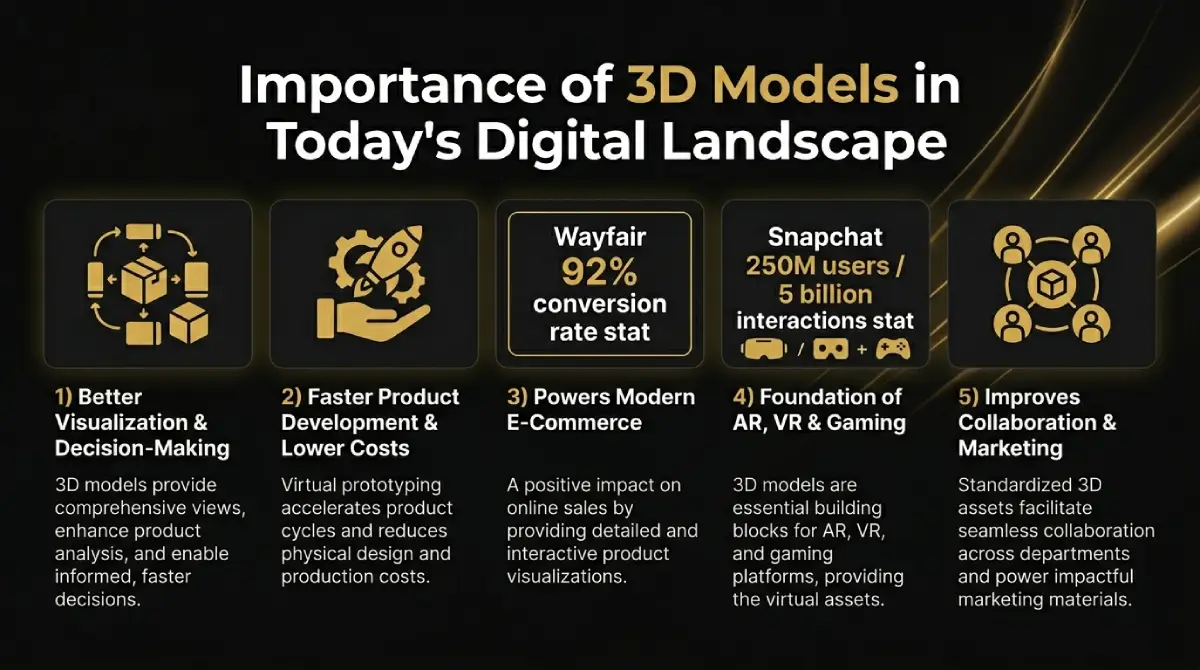
Here are some key advantages of 3D models in today's digital landscape:
Better Visualization and Decision-Making
Three-dimensional models are not limited to traditional 2D drawings. They provide clearer and more accurate representations of an object. They allow users to view an object from multiple angles, understand scale and proportion, and identify design flaws.
These more accurate visualizations help corporations make faster and more informed decisions in product design, engineering, and manufacturing.
Faster Product Development and Lower Costs
With 3D modeling and realistic rendering, virtual prototypes can be created quickly and efficiently. Designers can refine and test concepts without the need to manufacture multiple physical prototypes.
This leads to faster development cycles, reduced revision time, and lower production costs. Modern industries, including automotive manufacturing, rely heavily on 3D models for simulation and design.
Powers Modern E-Commerce Experiences
Three-dimensional modeling has transformed how customers interact with products. Customers can rotate products, zoom in on details, and customize variations to visualize products in their own ways.
These innovations help increase customer confidence and reduce product return rates. Wayfair saw a 92% increase in conversion rate after implementing its AR 'View in Room' feature, which lets customers place true-to-scale 3D furniture models directly into their own space using a smartphone.
Foundation of AR, VR, and Gaming
Three-dimensional models are the foundation of augmented reality (AR), virtual reality (VR), gaming, and other immersive experiences. Snapchat alone reported that over 250 million users engaged with AR shopping lenses more than 5 billion times, trying on and visualizing products from brands worldwide.
This signals a permanent shift in how consumers expect to interact with products before buying. Every virtual object, environment, and interactive component relies on 3D assets. Advanced 3D models are used in platforms to build interactive digital worlds.
Improves Collaboration and Marketing
A single 3D model can contain geometry, materials, dimensions, and technical specifications. It improves collaboration between designers, engineers, production teams, and marketers.
Product visuals, advertising assets, and marketing content can also be created quickly using 3D assets. It helps in reducing the need for time-consuming photoshoots and traditional photography.
Overview of Traditional vs. AI-Driven Approaches
The shift from traditional to AI-driven 3D modeling has changed how 3D assets are created and deployed across industries. Traditional approaches rely on a fixed, rule-based process for precision. On the other hand, AI-driven approaches use machine learning to provide efficient insights. In contrast, AI-driven approaches leverage machine learning to automate or speed up the creation.
In practice, most modern pipelines are shifting toward a hybrid workflow. AI is increasingly used for rapid generation and early-stage ideation, while artists refine, optimize, and finalize the outputs for production-ready use. The AI-generated 3D Models Market was valued at $1 billion in 2025 and is projected to reach $2.78 billion by 2032 at a CAGR of 15.62%.
| Factor | Traditional 3D Modeling | AI-Driven 3D Modeling |
| Workflow | Fully manual, step-by-step creation by skilled artists using modeling tools | Automated generation from text, images, or scans with AI assistance |
| Speed | Slow, often taking hours to weeks per asset | Very fast, producing base models in seconds to minutes |
| Skill Level | Requires strong technical and artistic expertise | More accessible, usable by beginners and non-specialists |
| Control | High precision and full control over geometry and detail | Limited direct control often requires post-editing |
| Quality | Consistent, clean, and production-ready outputs | Fast but variable quality, often needs refinement |
| Best Use | Final assets for film, games, CAD, and manufacturing | Concept design, prototyping, marketing, and rapid iteration |
The Role of Deep Learning in 3D Modeling
Deep learning is becoming an important method for efficient 3D object modeling. 3D modeling was a time-consuming manual process that required artists to recreate objects in digital form. Because of deep learning in 3D modeling, professionals can reduce both the time and effort needed to create 3D assets.
This allows industries like gaming, e-commerce, healthcare, and AR/VR to use 3D content more efficiently in their products and services.
- 3D Reconstruction and Geometry: Deep learning models can create point clouds and 3D objects from 2D images and scans. These models can also represent 3D objects as point sets, making the reconstruction process faster and more efficient.
- 3D Generation and Synthetic Assets: Modern AI systems can generate 3D models directly from images or simple text prompts. This makes text-to-3D workflows possible and supports faster prototyping, digital content creation, and visual experimentation.
- Neural Rendering and NeRF: Advanced AI techniques like NeRF simplify the process of generating and rendering 3D environments from 2D images. It can reconstruct scenes from multiple viewpoints and reduce the need for traditional mesh-based reconstruction in certain workflows.
- Optimization and Texture Automation: Machine learning can help generate textures, UVs, and materials while improving optimization. This automation reduces repetitive work and allows professionals to focus more on the creative and production-quality aspects of 3D modeling.
- Animation and Data Learning: Deep learning also improves the processing of dense 3D meshes and point clouds. This supports cleaner data structures and more effective animation workflows.
Point Clouds and Their Significance
Point clouds serve a broad spectrum of industries by providing a digital representation of an object, scene, or environment. A point cloud consists of discrete points in a three-dimensional coordinate system: X, Y, and Z. These points can also include additional attributes such as color or intensity.
Point cloud data can be gathered using modern technologies like LiDAR, photogrammetry, and digital depth sensors.
Though point clouds have some challenges, mainly because of their density and complexity. However, their use across many fields overshadows these limitations. Industries such as architecture, construction, surveying, robotics, and self-driving vehicles benefit from point clouds.
The main reason behind this is because they can capture real-world environments without requiring a fixed structure.
Key benefits include:
- Captures real-world geometry with a high level of spatial detail and accuracy.
- Generated through LiDAR, photogrammetry, and depth sensors.
- Serves as a foundation for reconstruction into mesh and CAD-ready 3D models.
- Frequently used in AEC, robotics, mapping, and inspection.
- Supports deep learning for better segmentation and scene understanding.
Conclusion
3D model creation has evolved from a purely manual, skill-intensive process into a technology-driven workflow powered by deep learning and generative modeling. These advancements have transformed 3D content creation across industries such as architecture, gaming, virtual and augmented reality, and healthcare.
Conventional techniques remain important for control, precision, and production readiness. Rather than replacing traditional workflows, AI enhances them through hybrid pipelines where machines handle speed and scalability while artists refine the final outputs.
Technologies like deep learning, neural rendering, and point clouds are becoming foundational to modern 3D workflows. As 3D modeling and intelligent systems continue to evolve together, AI will expand what is possible while traditional expertise ensures quality, functionality, and accuracy.
Frequently Asked Questions
What is 3D model creation?
3D model creation is the process of developing a digital representation of an object or surface in three-dimensional space. It involves defining geometry, adding textures and materials, and refining models for use in industries.
How does deep learning contribute to 3D modeling?
Deep learning contributes to 3D modeling by automating complex tasks. It also enables the creation of 3D assets from 2D images and enhances precision in fields like gaming and manufacturing.
What is progressive decoding in 3D generative models?
Progressive decoding is a technique that generates complex 3D objects in a step-wise manner. This approach improves the quality by refining geometry and texture in stages rather than generating all at once.
What are the applications of 3D modeling in e-commerce?
In e-commerce, 3D modeling is used to show products in an interactive way, including AR try-ons and customizable previews. Customers can rotate, zoom, and view items in detail, which helps them make better buying decisions and reduces product returns.
How can AI improve 3D reconstruction from 2D images?
AI improves 3D reconstruction from 2D images by making it faster and more accurate, even when only limited views are available. Deep learning can fill in missing parts, create point clouds or meshes, and build full 3D objects from limited or partial images.
What is Holosnap?
Holosnap is an AI-driven concept focused on capturing real-world objects using simple inputs like images or scans and converting them into usable 3D digital models. It demonstrates how generative modeling can simplify 3D asset creation for AR, VR, and digital content pipelines.
What is the future of 3D modeling with deep learning?
The future of 3D modeling is focused on faster, AI-powered asset creation. It will mostly work as a hybrid system, with AI generating models and humans refining the final results. New advances will make asset creation quicker and easier across different industries.