

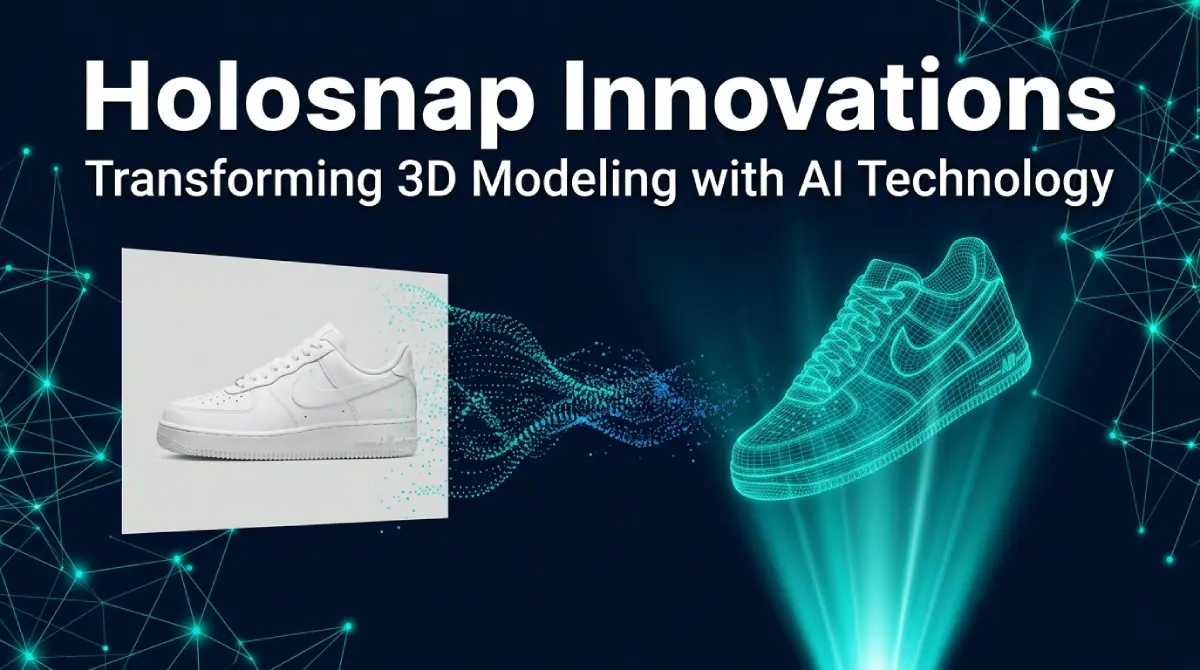
3D modeling is no longer just a design tool. It has become a core infrastructure for the future digital economy across all industries. While it's always been powerful, it's also been expensive, time-consuming, and dependent on specialized skills.
For businesses that need high-quality 3D content at scale, traditional workflows have struggled to keep up with growing demand. That is exactly the gap Holosnap is built to solve.
In this article, we’ll go through why 3D modeling has become so important for modern businesses and digital experiences. We’ll also explore how AI is making 3D creation faster and easier. How Holosnap uses AI, computer vision, and point cloud technology to turn simple 2D images into useful 3D models will also be covered.
Key Takeaways
- 3D modeling is now essential for modern digital experiences.
- Holosnap turns 2D images into 3D models using AI and point cloud technology.
- It helps businesses create 3D content faster, easier, and at scale.
What Makes 3D Modeling So Crucial Today?
3D modeling has become so crucial in today's digital landscape because it acts as a versatile tool. Nearly every industry, product, and experience involves 3D modeling, and billions of people interact with it every day. Industry analysts project that the 3D mapping and modeling sector will expand to USD 32.10 billion by 2032, with a compound annual growth rate of 24.9%, underscoring its rapidly increasing importance in the global economy.
It has bridged the gap between digital concepts and physical reality across manufacturing, architecture, gaming, healthcare, and other industries.
It is crucial because it transforms ideas into precise and testable digital assets. It accelerates the development, reduces costs, and improves collaboration. It also enables new experiences like AR, VR, and digital twins.
Here are some key reasons why 3D modeling is so crucial:
- Faster Development and Lower Costs: It enables rapid prototyping, virtual testing, and faster design iterations. It also cuts manufacturing expenses, minimizes wasted materials, and eliminates reliance on physical prototypes.
- Better Accuracy and Collaboration: 3D modeling improves precision with realistic geometry and simulations. It also enhances the shared visual workflows for designers, engineers, manufacturers, and clients.
- Essential for Manufacturing and Construction: Modern industries use 3D models for CAD/CAM, CNC, and 3D printing for rapid prototyping. Building Information Modeling (BIM) improves planning, visualization, and coordination of construction projects and helps avoid costly on-site mistakes.
- Powers Entertainment, AR, and VR: Video games, animation, VFX, and AR/VR experiences are all built with 3D models. As a result of the industry's continued investment in immersive technologies, the demand for 3D content continues to grow exponentially.
- Supports Healthcare and Training: Three-dimensional modeling is extensively used for surgical planning, visualization, prosthetics and implants, and training simulations in healthcare. It is also used in engineering, aviation, and military training to create realistic simulations for hands-on learning.
- Drives Future Technologies: 3D modeling plays a key role in AI-driven workflows, robotics, digital twins, automation, and real-time rendering, making it a foundational technology for the future digital economy.
The Role of AI in Transforming 3D Modeling
AI is reshaping the 3D modeling landscape by automating labor-intensive and technically complex processes, saving both time and effort. AI-powered design can generate solutions at speeds beyond human capability and accelerate complex workflows.
Computer vision enables automation in modeling by analyzing 2D images to reconstruct accurate 3D structures. Tasks like retopology, UV mapping, texturing, and mesh generation can now be handled much faster with AI. It allows designers to focus more on refinement and final output.
In addition, 3D models can be generated directly from text prompts or images, further simplifying the creation process. Overall, AI improves design quality, accelerates prototyping, and enables industries like gaming, healthcare, AR/VR, and e-commerce to scale content production efficiently.
Introducing Holosnap: A Game-Changer by The KOW Company
Holosnap is an AI-powered 3D modeling platform designed to redefine industries, including e-commerce, advertising, AR/VR, and digital content creation at scale. The main purpose behind Holosnap is to make 3D workflows faster, more accurate, and user-friendly. Along with Retouched.ai and Omnimage, it represents an expansion of The KOW Company’s artificial intelligence suite.
Holosnap uses artificial intelligence to turn 2D images into 3D models effortlessly. Advanced AI technology in Holosnap's platform enables the rapid generation of high-quality 3D models that match the detail and usability of traditionally created assets.
It eliminates the time, cost, and complexities of traditional 3D modeling. It's also accessible for designers, product teams, and brands. For industries dependent on 3D models, such as advertising, digital content, and AR/VR, Holosnap rapidly meets those needs. Holosnap values the role of human creativity to provide vision and refine the final product.
How Holosnap Leverages Cutting-Edge Tech Like Point Clouds
Holosnap is built on advanced AI and computer vision techniques to transform 2D images into structured, high-quality 3D models. The main enabler of this process is point cloud technology, which acts as the bridge between flat visuals and full 3D geometry.
It is supported by modern deep learning that enables rapid and detailed 3D assets without manual modeling.
- Single Image to 3D: The system takes one image and estimates depth, shape, and structure to understand the object in 3D, even filling in missing details.
- Point Cloud Creation: The system produces a point cloud, a cluster of spatial coordinates that approximates the object's form.
- Understanding Structure with AI: AI studies how these points connect to understand edges, curves, and overall form, improving accuracy.
- Organizing the Data: The information is structured to keep the model stable, clean, and consistent during generation.
- Building Step by Step: The 3D model is built gradually, adding detail and refinement at each stage instead of all at once.
Real-World Applications: Why Holosnap Matters to Your Business
Holosnap helps businesses turn 2D images into 3D assets quickly and at scale. It reduces time, cost, and manual modeling efforts. This simplifies the production of premium 3D assets for use in marketing campaigns, sales materials, and product displays.
Studies show that customers engaging with 3D product visualizations are 67% more likely to complete high-value purchases of $2,500 or more, demonstrating the direct business impact of interactive 3D content.
Key business applications include:
- E-commerce and Retail: It converts product photos into interactive 3D models for product pages, AR previews, and virtual showrooms. This helps improve customer engagement and reduce return rates.
- Fashion and Apparel: It supports virtual try-ons, digital lookbooks, and AR shopping experiences, making it easier to manage and showcase large collections.
- Marketing and Advertising: Enables faster creation of campaign-ready 3D visuals and product variations, helping brands produce high-quality content with less effort.
- Architecture and Real Estate: Quickly generates 3D visualizations from design references or images for presentations, planning, and client marketing without heavy rendering workflows.
- Gaming and Entertainment: Speeds up 3D asset creation from concept images and references, reducing manual modeling time in production.
- Manufacturing and Product Design: Enables quick 3D prototypes and visualizations for design reviews, communication, and early-stage development.
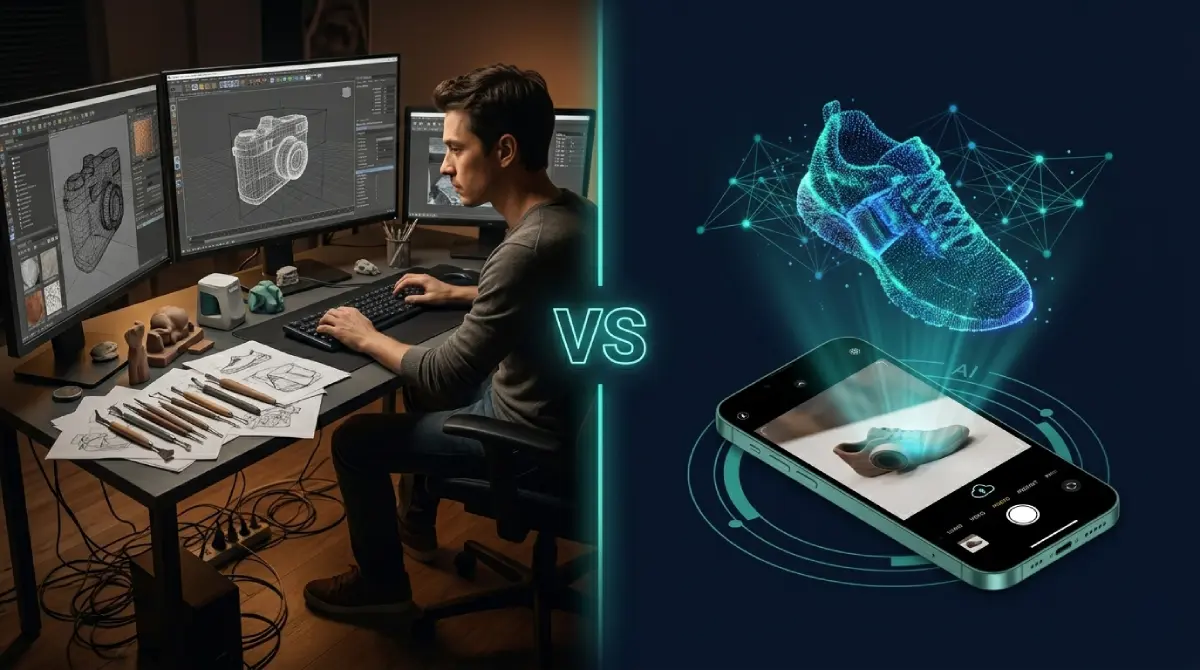
Holosnap vs. Traditional 3D Modeling: What Sets It Apart?
Holosnap is different from traditional 3D modeling because it uses AI to automate and speed up the creation process. Compared to conventional 3D modeling, it accelerates workflows, improves scalability, and lowers the barrier to entry.
Here are some key differences between Holosnap and Traditional 3D modeling:
| Aspect | Traditional 3D Modeling | Holosnap AI 3D Modeling |
| Input | Built manually from references or sketches | Single image or simple visual input |
| Creation Method | Manual modeling, sculpting, and texturing | AI-generated using point clouds and generative models |
| Speed | Hours to days per model | Minutes per model |
| Cost | Higher due to manual labor | Lower for large-scale production |
| Skill Required | Requires expert 3D artists | Minimal technical expertise for base generation |
| Scalability | Limited by manual effort | Designed for high-volume output |
Conclusion
3D modeling has become a core technology in today's digital landscape. It enables faster development, improved accuracy, cost efficiency, and new digital experiences. With the help of tools like Holosnap, creating high-quality 3D content has become more accessible than ever.
With Holosnap, users can generate realistic, professional-grade 3D content within minutes. Whether you're a global retailer or a small business looking to scale content production, Holosnap is a powerful solution.
The KOW Company’s vision is simple: to make generative AI-powered 3D creation accessible to everyone. The main focus is on removing technical barriers and enabling a new era of creativity, efficiency, and visual storytelling.
Frequently Asked Questions
What is Holosnap, and how does it work?
Holosnap is an AI-powered 3D modeling platform that converts 2D images into 3D models. It analyzes the image's depth, shape, and structure, and uses AI techniques to build a complete 3D asset.
Can Holosnap be used for e-commerce product visualization?
Yes, Holosnap can be used for e-commerce product visualization. It is well-suited for e-commerce because it can quickly turn product images into interactive 3D models. These assets work seamlessly across product listings, augmented reality previews, and immersive virtual showrooms.
What kind of inputs does Holosnap need to create a 3D model?
Holosnap needs just a single 2D image of an object. The core system of Holosnap is designed to generate 3D models from one visual input.
What industries can benefit from using Holosnap for 3D modeling?
Industries like e-commerce, fashion, marketing, architecture, real estate, gaming, manufacturing, and digital content creation can benefit from using Holosnap for 3D modeling.
What are point clouds, and why are they important in 3D modeling?
A point cloud consists of numerous spatial data points that collectively define an object's three-dimensional structure. Point clouds are important because they form the initial structure that AI uses to build models.
How can I get started with Holosnap for my 3D modeling needs?
Getting started with Holosnap is simple. To get started, users simply sign up, upload reference images, and let Holosnap generate a 3D model that can be refined for their needs.