

Product visualization is no longer limited to static images or traditional rendering. Nowadays, it lets users view and interact with realistic 3D products instantly. This is mainly used in virtual showrooms, product configurators, AR experiences, and interactive experiences.
According to Shopify, 91% of shoppers say that 3D visualization has improved their shopping experiences. This shows that people now prefer product experiences that are more interactive and engaging. With the new improvements, businesses can now create scalable, photorealistic digital experiences that improve both customer engagement and the overall product design process.
In this article, we will explore how real-time rendering is transforming modern product visualization. We will go through different types of real-time rendering, how they work, and where they are commonly used. We will also cover the key benefits, industry applications, and technologies driving the change.
Key Takeaway
- Real-time rendering is replacing static visuals with interactive, photorealistic 3D experiences.
- AI, AR/VR, cloud rendering, and hybrid rendering are making 3D visualization faster, smarter, and more accessible.
- Industries like e-commerce, automotive, architecture, and gaming use real-time rendering to improve customer experience, design workflows, and sales.
- The future of product visualization will be more immersive, scalable, and driven by real-time 3D technologies.
What is Real-Time Rendering for Product Visualization?
Real-time rendering is the process of creating 3D visuals so that users can interact with a product smoothly while browsing.
Unlike traditional rendering, which relies on fixed static images, real-time rendering allows users to interact with products virtually. Users can rotate, zoom in, and customize products while receiving instant visual feedback.
These visuals are usually rendered at 30 to 60 frames per second. This makes the experience smooth and easy to use. Real-time rendering is now widely used in e-commerce, automotive visualization, furniture configurators, virtual showrooms, AR/VR, and fast product prototyping.
Real-Time Rendering vs Traditional Rendering
| Feature | Real-Time Rendering | Traditional Rendering |
| Speed | Instant updates | Minutes to hours |
| Interactivity | Fully interactive | Static images |
| Use Cases | Design reviews, e-commerce, AR/VR | Final marketing visuals, ultra-high fidelity |
| Hardware Needs | Strong GPU, optimized software | High-performance CPU/GPU clusters |
| Cost Efficiency | Saves time & prototypes | Higher costs for revisions |
Different Types of Real-Time Rendering
There are many types of real-time rendering, and each works differently. Each type balances quality, performance, and hardware requirements in its own way. Some prioritize speed and device compatibility, while others focus on achieving highly realistic visuals.
Here are some of the main types of real-time rendering used in product visualization:
Rasterization-Based Rendering
Rasterization is one of the most popular methods of real-time rendering and is the fastest way to convert 3D models into a 2D pixel-based image.
Because of this speed, it is the most widely used method of rendering in applications, such as interactive web-based product viewers and mobile applications.
The realism of modern rasterization-based renderers can be greatly improved by using screen-space ambient occlusion, screen-space reflections, and lighting techniques that enhance visuals without slowing rendering speed.
Best for:
- E-commerce product viewers
- Web configurators
- Mobile applications
- Interactive 3D experiences
Real-Time Ray Tracing
The main feature of real-time ray tracing is its ability to create realistic scenes by showing how light behaves in the real world.
In the last several years, improvements in graphics processing units have made it possible to use real-time ray tracing in interactive graphics with photorealistic quality.
Best for:
- Automotive visualization
- Luxury products
- Jewelry rendering
- High-end marketing visuals
Hybrid Rendering
Hybrid rendering creates a balance between speed and realism. It uses rasterization for fast rendering of product models and ray tracing for realistic reflections, shadows, and lighting.
Because of this balance between speed and quality, hybrid rendering is one of the leading methods used in product visualization.
Best for:
- Product configurators
- Architectural visualization
- Design reviews
- Interactive showrooms
Real-Time Volumetric Rendering
Volumetric rendering goes beyond simple solid object rendering. It includes the visual appearance of smoke, fog, light effects, and other translucent materials or objects in a scene. These effects are often known as atmospheric effects.
Best for:
- Cosmetic visualizations
- Creating visualizations for drinks
- Food and candle products
- Rendering translucent materials
Real-Time Path Tracing
Real-time path tracing is one of the most accurate rendering methods. It creates highly realistic lighting, reflections, and shadows by simulating multiple bounces of light. Modern GPUs and AI denoise make real-time path tracing possible for creating very high-quality images.
Best for:
- Creating marketing materials for high-end products
- Product visuals for cinematic presentations
- Marketing materials for luxury brands
- Creating photorealistic visualizations
AR and VR Real-Time Rendering
AR and VR rendering systems are designed to deliver deeply immersive digital experiences. A Shopify study shows that customers were 65% more likely to place an order after interacting with a product in AR.
VR puts users in a fully digital world, while AR adds digital products into the real world. AR and VR environments depend on real-time rendering that maintains high frame rates and extremely low latency.
Best for:
- Virtual try-on experiences
- Visualizing furniture in a home
- Virtual showrooms
- Creating an engaging in-store experience
Core Benefits of Real-Time Rendering in Product Visualization
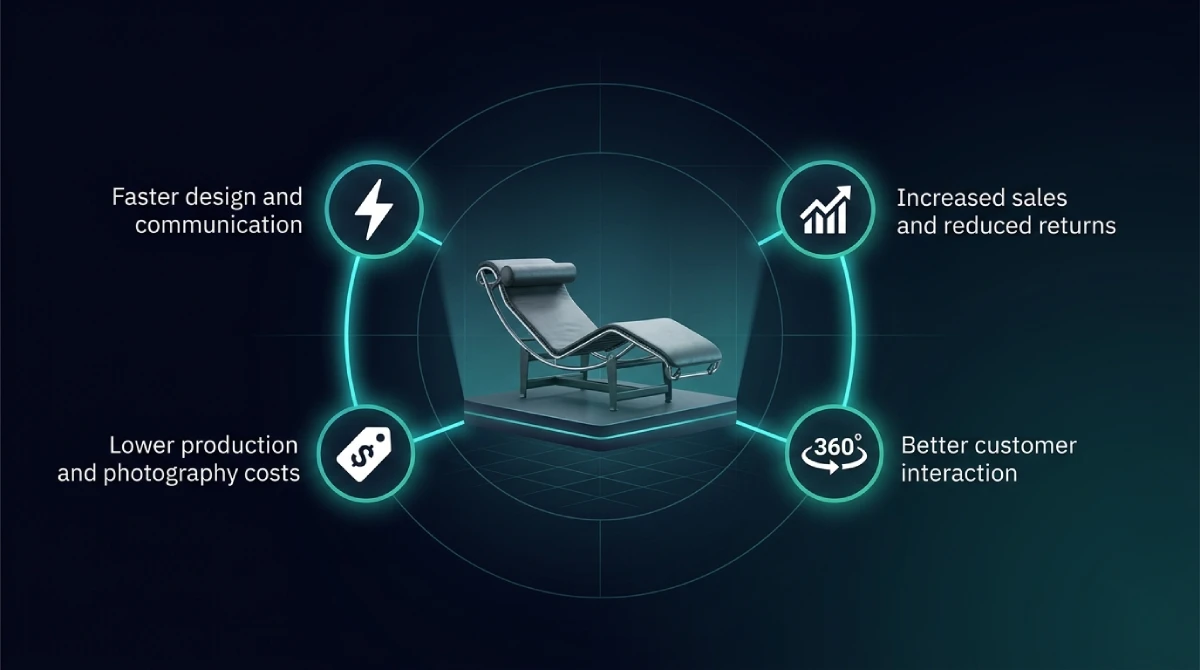
Real-time rendering improves how products are designed, reviewed, and sold through interactive visuals. Here's a list of the main benefits:
Faster Design and Better Communication
With real-time rendering, product design updates can be seen within seconds. Changes to materials, lighting, textures, and 3D models can be reviewed by design teams, engineers, and clients in the same visual workspace.
This improves collaboration, makes communication clearer, and speeds up design approval. It also supports the product design process, visual storytelling, architectural visualization, and project planning.
Lowered Costs for Production, Photography, and Prototyping
One 3D model can help businesses reduce costs by removing the need for multiple photoshoots and physical prototypes. Businesses can create many product variations without extra studio or post-production costs.
This is especially valuable for e-commerce, marketing images, product visualization, and architectural visualization. Any use case that requires high-volume visual output can benefit from this.
Better Customer Interaction and Interactive Shopping
Real-time 3D models allow shoppers to interact with products, view them from any angle, and zoom in or out.
With 3D marketing and 3D product visualization, customers can view products before purchasing and better understand scale, materials, lighting, and textures.
Endless Customization and Personalization
With the ability to configure in real time, customers have the ability to change colors and materials, as well as the design options, to customize the product more easily.
This is commonly seen in industries such as furniture, fashion, automotive, and electronics. It improves the user journey in interactive product design and visualization systems, while also reducing the need for extra production steps.
Increased Sales and Reduced Returns
Realistic product visualization makes online purchases easier. Items rendered in 3D are more likely to sell as customers are able to see materials, lighting, and textures before purchasing. This is especially useful for product marketing and visualization because it helps customers make more confident buying decisions.
Real-World Applications Across Industries
Real-time rendering is used across industries that use 3D product visualization for presentation, marketing, training, customer interaction, and better decision-making.
- E-commerce, Retail, and Fashion: These sectors use virtual product viewers, configurators, and AR try-on tools that allow customers to interact with products in real time. Users can rotate, explore, and customize items, which improves customer experience, product visualization, and buying confidence.
- Automotive, Architecture, and Real Estate: Real-time rendering supports virtual showrooms, architectural visualization, and interior/exterior previews. It helps teams and clients view design changes instantly, making design review, sales, and planning workflows faster and more efficient.
- Product Design, Manufacturing, and Electronics: It enables virtual prototyping, product visualization, and engineering review without needing physical prototypes. This helps design teams test ideas faster and improve collaboration during the product development and design process.
- Healthcare, Industrial Training, and Medical Simulations: Real-time rendering is used for 3D simulations, training environments, and digital twins. It allows safe practice in controlled virtual settings and supports better learning in medical and industrial training systems.
- Marketing, Gaming, and Digital Media: It powers interactive campaigns, real-time ads, and immersive digital content. The gaming industry plays a major role in advancing real-time rendering technologies used across marketing visuals and digital experiences.
- Web, AR/VR, and Cloud Platforms: Real-time rendering enables lightweight 3D visualization, AR experiences, and cloud-based rendering even on low-end devices. This makes interactive 3D content more accessible across web and mobile platforms.
Technological Innovations Driving the Change
Real-time rendering is growing fast due to better GPUs, modern workflows, and advances in computer graphics, making real-time 3D visualization more accessible. Hybrid rendering combines rasterization and ray tracing to improve lighting, reflections, and global illumination while maintaining real-time performance.
AI-driven tools like denoising, texture optimization, and 3D Gaussian Splatting improve speed and quality in 3D rendering workflows. Game engines such as Unreal Engine and Unity, along with tools like Enscape and Twinmotion, now support PBR materials, global illumination, and large 3D environments used in architecture, product visualization, and marketing.
Cloud rendering and WebGPU enable high-quality graphics across devices without heavy hardware. Overall, hardware, AI, and rendering advances are transforming 3D visualization and digital design.
The Future Outlook of Real-Time Rendering in Product Visualization
Real-time rendering and 3D visualization are expected to further reshape how static images and traditional videos are used in the coming years. Product visualization used to rely on static images and simple animations.
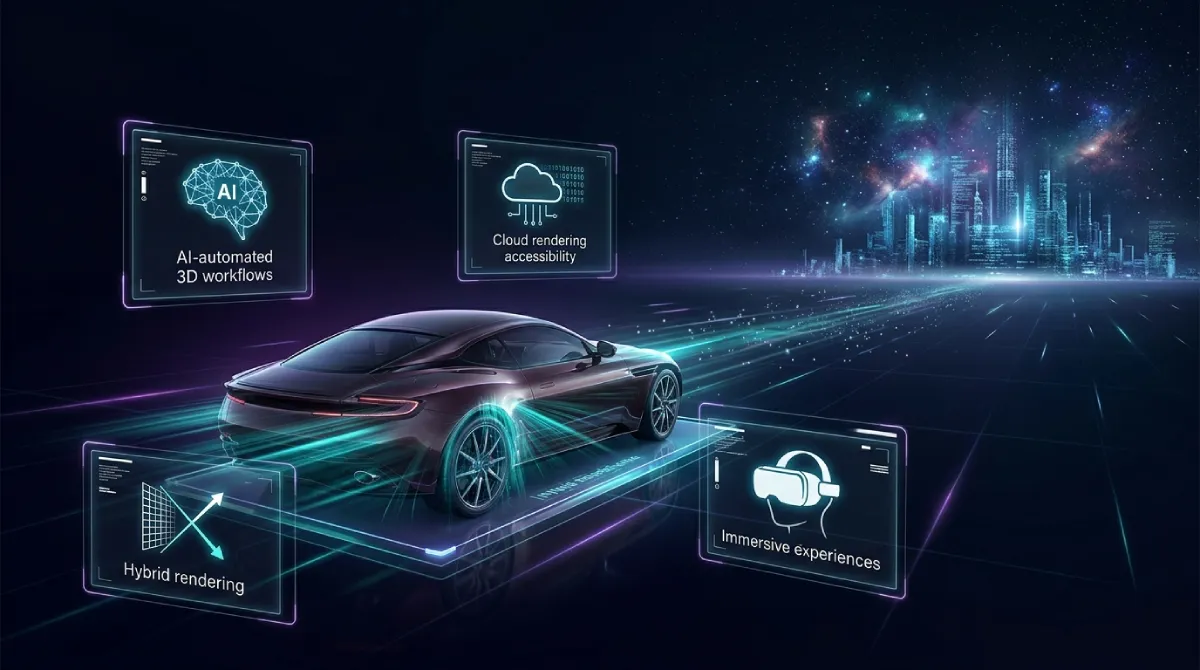
With advances in real-time rendering, it now includes interactive, photorealistic 3D experiences powered by AI, cloud computing, and improved GPU hardware.
AI Will Automate More of the 3D Workflow
The role of AI will expand into real-time rendering workflows, including material generation, lighting setup, scene creation, denoising, upscaling, and even 3D asset generation.
These AI-driven tools will support automated 3D rendering workflows that adapt visuals based on user needs, making product visualization faster, more consistent, and more scalable.
Cloud Rendering Will Make 3D More Accessible
The integration of WebGPU, cloud rendering, and real-time rendering engines removes the need for high-end hardware.
High-quality 3D rendering and product visualization can now be streamed across devices, making interactive 3D experiences accessible on both desktop and mobile platforms.
AR and VR Will Create More Immersive Experiences
AR and VR visualization, including virtual showrooms, spatial shopping, and AR try-on experiences, will become standard use cases of real-time rendering. 71% of consumers say they would shop more frequently if AR is an option.
High-quality 3D product models will enable more immersive customer engagement, allowing users to interact with products in real-world or fully virtual environments.
Hybrid Rendering Will Become the Standard
The combination of rasterization, real-time ray tracing, and hybrid rendering will become the standard for achieving near-photorealistic quality in real time.
Game engines like Unreal Engine and Unity will continue driving this ecosystem, enabling reusable 3D assets, real-time rendering workflows, and cross-platform product visualization across design, marketing, and sales.
Conclusion
In the coming years, products will no longer be viewed only through traditional, static visuals. The goal of product design and visualization is to move toward fully 3D environments that users can explore and modify. This will help teams communicate more effectively, improve the design process, and reduce digital engagement costs.
From e-commerce to automotive, architecture, healthcare, and entertainment, real-time rendering is becoming a standard for product showcasing and decision-making.
Hybrid rendering, AI-powered automation, cloud infrastructure, and advanced game engines make it possible to achieve with near-photorealistic quality, scalability, and lower effort.
The advancement of real-time rendering, along with the rapid development of AI, AR, and VR, is likely to change many traditional visualization methods. It will improve not only how products are displayed in a digital and interactive environment, but also how products are created, promoted, and experienced.
Frequently Asked Questions
How does real-time rendering differ from traditional rendering?
Real-time rendering generates 3D images instantly by prioritizing speed and interactivity. On the other hand, traditional rendering produces pre-rendered visuals that may take minutes or hours to achieve high photorealism.
How does real-time rendering improve customer experience?
Real-time rendering improves customer experience by providing instant, interactive 3D visualization. It allows users to explore the product in 360 degrees and make informed decisions instantly.
What industries benefit the most from real-time rendering?
There are many industries that benefit from real-time rendering. Among them, industries like e-commerce, automotive, architecture, real estate, furniture, fashion, gaming, and healthcare benefit the most. These industries rely heavily on product visualization, design review, and immersive customer experiences.
How much do real-time rendering services cost?
Real-time rendering usually ranges from $1,500 to $5,000 per project. Costs usually depend on project complexity, visual quality, and platform requirements. Simple web-based configurators can be relatively affordable, while high-end photorealistic or cloud-rendered solutions can be expensive.
Can I use real-time rendering for e-commerce product visualization?
Yes. Real-time rendering is highly effective for e-commerce product visualization. It is usually used in e-commerce through 3D product views, AR previews, and configurators. It enables customers to explore products before buying, which helps improve conversion rates and reduce product returns.
Is real-time rendering suitable for small businesses or startups?
Yes, real-time rendering is highly suitable for small businesses or startups. It enables faster iteration, lower cost, and improves client communication. With the help of modern tools, small businesses can now use real-time 3D without heavy infrastructure costs.
What is the role of AI in real-time rendering?
AI plays an important role in real-time rendering by supporting traditional workflows with intelligent automation. It reduces the manual workload and helps to provide realistic visuals faster.
Can I use real-time rendering for architectural visualization?
Yes, you can use real-time rendering for architectural visualization. It is widely used in architecture for real-time walkthroughs, lighting changes, and client presentations.
How does real-time volumetric rendering differ from traditional rendering?
Real-time volumetric rendering prioritizes effects like fog, smoke, and light scattering within a volume, rather than just rendering surfaces. Traditional rendering usually creates pre-rendered images or animations, while volumetric rendering focuses on effects like fog, smoke, and light scattering inside a 3D space.
How does real-time rendering compare to pre-rendered visuals?
Real-time rendering usually generates visuals instantly, like 30-60+ frames per second, while pre-rendered visuals are static and high-quality images that can't be changed in real time.
How does real-time rendering compare with ray tracing?
Real-time rendering is a broader category that includes multiple techniques. Ray tracing is one method that simulates realistic light behavior for highly accurate reflections and shadows.