

3D rendering has evolved from specialized tools into essential technology across industries. The global market is already in the multi-billion-dollar range and continues to grow steadily into the early 2030s.
Demand for real-time visuals and immersive content is driving this growth. With AI workflows, interactive engines, and cloud collaboration, production times are becoming shorter. Architecture, gaming, e-commerce, and automotive sectors now rely on 3D rendering. It turns static ideas into dynamic experiences. Teams can iterate faster, communicate more clearly, and engage clients more effectively.
What Are 3D Rendering Trends in 2026?
In 2026, 3D rendering trends are focused on AI-driven automation and more realistic, immersive experiences. AI is handling a growing share of repetitive digital production work. By automating the creation of 3D models, textures, and scene settings, AI is reducing production time and manual effort.
AR and real-time rendering are turning static visuals into interactive walkthroughs and live design edits. By reducing hardware limitations and supporting global collaboration, cloud-based rendering is making advanced workflows more accessible.
Meanwhile, virtual prototyping is becoming more common because of sustainability concerns. This reduces the need for physical samples and helps cut material waste. Better 3D content authenticity, creativity, and impact across industries also come from balancing hyper-realism with subtle imperfections and experimenting with hybrid artistic forms.
Top 5 Trends in 3D Rendering to Watch in 2026
Since 2025, 3D rendering has been moving beyond purely technical output toward faster, more sustainable, and more immersive experiences. Professionals across industries are adapting to these shifts to speed up work and improve visual quality.
Here are the top 5 trends in 3D rendering to consider:
AI-Assisted Texturing & Generative Modeling
For PBR material synthesis, AI has become deeply integrated as a support tool. It allows professionals to iterate on materials like brushed metal, aged oak, and polished stone more quickly during concept development and client review.
Generative AI can now do more than just texture objects. It can also help generate 3D models, scene elements, and crowd assets. This makes tasks like UV mapping, material adjustments, and scene assembly much less repetitive. The main benefit is faster processing without compromising artistic integrity, allowing artists to focus more on story, lighting, and composition while AI handles repetitive manual work.
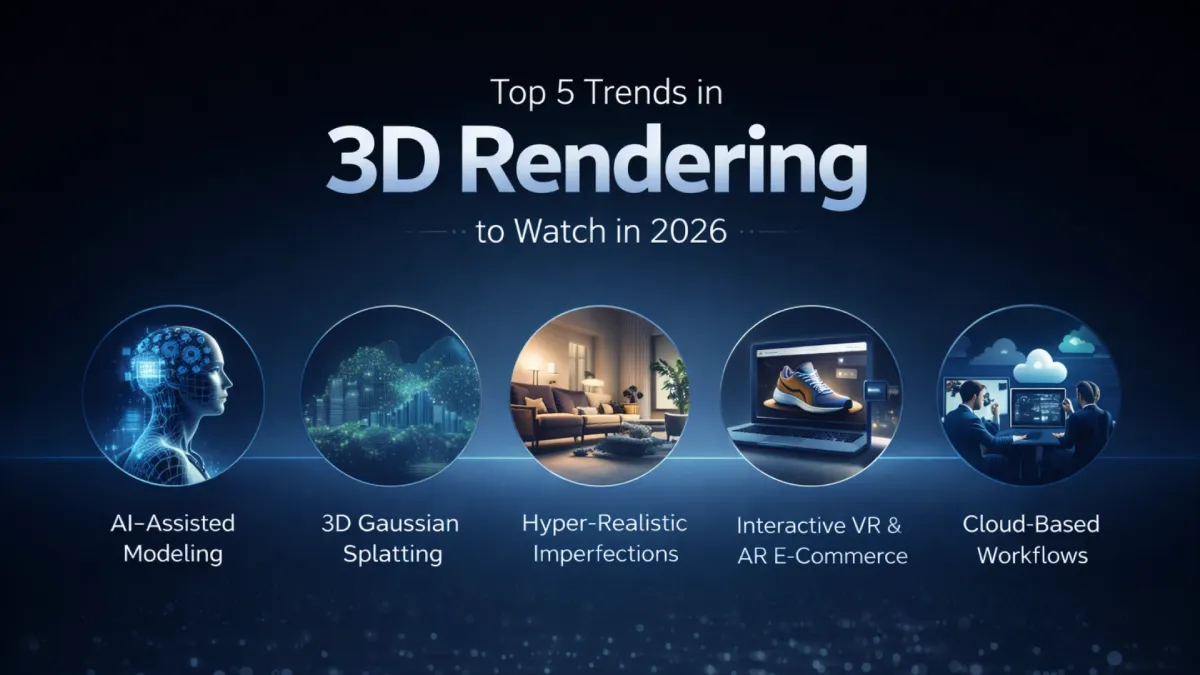
3D Gaussian Splatting (3DGS)
3D Gaussian Splatting has moved from research into practical workflows alongside photogrammetry and manual modeling. It is especially useful for creating photorealistic environments outside the classic polygon-heavy pipeline.
It can produce highly realistic visuals while still performing well in complex scenes. Visualization studios, architecture firms, and product designers no longer need to sacrifice as much realism for efficiency. Whether rendering urban parks, interiors, or industrial layouts, 3DGS is becoming more valuable for projects that need both speed and visual fidelity.
The “Lived-In” Look / Hyper-Realistic Imperfections
Today, professionals are adding subtle imperfections instead of making every render look overly polished. They introduce atmospheric detail, natural texture variation, and environmental nuance to make scenes feel more inhabited and relatable.
This approach builds emotional engagement by helping clients and viewers connect more naturally with spaces and products. Real estate and lifestyle product visualization benefit greatly from cinematic lighting, human-scale details, and careful arrangement that give renders a more photographic quality. This makes it easier for stakeholders to imagine themselves in the space.
Interactive Web-Based VR & AR Experiences
Interactive web-based VR and AR experiences deliver immersive 3D content directly through browsers without requiring app downloads. They rely on technologies like WebXR, WebGL, and libraries such as Three.js and Babylon.js.
In 2026, these experiences are growing quickly in e-commerce, where customers can preview products in 3D before buying. They also support virtual labs, interactive simulations, and collaborative digital environments through multi-user workspaces. These experiences are becoming more common in mainstream digital interaction because they improve realism, usability, and engagement.
Cloud-Based Collaborative Workflows
Cloud-based workflows are changing how teams create, review, and finalize 3D content by centralizing rendering and asset management in the cloud. Artists and editors can share and review files in real time, while heavy tasks like rendering are handled by powerful cloud servers.
This speeds up projects, keeps files more organized, and reduces the need for expensive local hardware. It also gives teams a more efficient way to stay aligned across locations and move work forward with fewer bottlenecks.
3D Rendering Market Size & Growth Analysis
The global 3D rendering market has seen significant growth in recent years. It is already valued in the multi-billion-dollar range and is expected to continue expanding through 2025–2026. Long-term estimates suggest it could reach around $19.82 billion by 2033, with strong compound annual growth throughout the forecast period.
This growth is being driven by multiple industries. Construction, gaming, healthcare, automotive, and e-commerce are all using 3D rendering for applications such as building design, product visualization, simulations, marketing assets, and digital experiences. North America continues to hold a major share of the market, while Asia-Pacific is growing rapidly due to strong momentum in gaming, online retail, and smart-city initiatives.
Industry trends also show gaming, advertising, media, AI, and cloud technologies pushing the market forward by enabling real-time collaboration and faster production workflows.
How AI & Machine Learning Are Transforming 3D Rendering
AI and machine learning are turning 3D rendering from a slow, hardware-dependent process into a faster, smarter, and more accessible workflow. In many cases, they are significantly reducing render times without sacrificing photorealism.
- Speed & Real-Time Feedback: AI denoising cleans noisy renders much faster, while tools like NVIDIA DLSS upscale lower-resolution frames to high definition. This gives artists more immediate feedback without depending entirely on raw hardware power.
- Smarter Lighting & Realism: AI can simulate more realistic lighting, reflections, and shadows automatically. GANs and related models also help generate textures and support material mapping, bringing digital scenes closer to photorealistic results.
- Workflow Automation: Artists can now generate 3D assets from a sketch, photo, or text prompt in much less time. Scene setup and environment building, once time-heavy tasks, are increasingly supported by AI tools.
- Industry Impact: Architecture firms can produce photorealistic walkthroughs before construction begins. Game studios can reach higher fidelity with faster iteration. E-commerce brands can build large product catalogs and campaign visuals without relying entirely on traditional photoshoots.
- Challenges & What’s Next: Consistency, precision, and setup costs still remain real barriers, especially for smaller teams. But the direction is clear: AI is evolving from a speed tool into a practical creative co-pilot, helping with refinement while leaving vision and decision-making in human hands.
Top 5 3D Rendering Technology Advances in 2026
3D rendering continues to grow in 2026 because of advances in AI, real-time processing, and cloud computing. It is now faster, more flexible, and more accessible across industries.
1. AI-Powered Neural Rendering - Cutting Render Times by 70%
AI-powered neural rendering is changing the way rendering is done. With improvements in automated denoising, lighting assistance, and scene optimization, it is now possible to reduce rendering time significantly.
In large-scale rendering environments, achieving high-pixel photorealistic visuals in far less time is becoming more practical. This allows quicker iteration and makes advanced rendering more accessible, even on lower-end equipment.
2. Real-Time Rendering & GPU Acceleration Technology
With improved GPUs and real-time engines, users can now work with a level of visual fidelity and responsiveness that allows near-instant previews. This is especially valuable in gaming, architecture, and VFX.
Modern GPU technology supports faster ray tracing, real-time rendering, and AI-based upscaling, making interactive workflows far more practical than before.
3. 3D Gaussian Splatting - The Next Rendering Standard
3D Gaussian Splatting is emerging as a powerful rendering approach for photorealistic visualization. It supports high-resolution and high-frame-rate scene representation, especially for environments reconstructed from images or video.
Because of its speed and realism, real-time 3D Gaussian Splatting is becoming more useful for large-scale visualization and VR-related use cases.
4. Cloud Rendering & Distributed Render Farms
The accessibility of powerful GPU resources on demand has made cloud rendering an essential part of modern production. Distributed render farms help process complex scenes quickly while reducing the pressure of large hardware investments.
They also support remote rendering, allowing studios of different sizes to create high-quality assets in a scalable and efficient way.
5. Procedural Generation & AI Mesh Creation
Recent procedural generation and AI mesh creation technologies can automatically build a wide range of 3D assets, from landscapes to complex architectural structures and environments.
These technologies reduce manual production effort, speed up content generation, and help maintain consistency when large volumes of assets need to be created.
3D Rendering Software & Hardware Innovations 2026
In 2026, the 3D rendering industry looks very different from previous years. Rendering software is becoming easier to use, more responsive, and increasingly supported by automation. Repetitive tasks are handled more efficiently, and CAD and BIM systems are integrating better with cloud workflows. This reduces production time and makes high-quality photorealistic output more achievable.
Popular software like V-Ray and Chaos Corona still lead in realistic rendering. Tools such as 3ds Max, Blender, D5 Render, and Enscape are adding more real-time and AI-supported features. Unreal Engine and Twinmotion continue focusing on interactive experiences, including VR walkthroughs and browser-based real-time rendering.
On the hardware side, new GPUs such as NVIDIA’s RTX 5090 and RTX PRO 6000 are significantly faster and offer more memory. They can handle complex scenes both locally and in the cloud. Cloud rendering is also making high-quality output more affordable and accessible for teams and individual creators.
AI now supports tasks like denoising, texture generation, and scene improvement. Together with digital twins, interactive storytelling, and virtual prototyping, these developments are making 3D rendering faster, simpler, and more widely usable.
Cloud Rendering vs. Local Rendering - Which Is Better?
The better option depends mostly on project size, deadlines, budget, and workflow needs. Cloud rendering is often better for large, deadline-driven projects. Local rendering, on the other hand, offers greater control and immediate access.
Here’s a quick comparison for better understanding:
| Aspect | Cloud Rendering | Local Rendering |
| Cost | Pay-per-use ($0.01-$0.68/core-hour); scalable; 3-year savings up to $54K | High upfront and maintenance costs with no ongoing fees |
| Speed | 20-50x faster via 100+ nodes (10-30 min/scene) | Limited by hardware (8-12 hrs/scene on 16-core rig) |
| Scalability | Unlimited on-demand; auto-scale for peaks | Fixed and upgrades are slow and kinda costly |
| Privacy and Security | Encrypted, ISO-certified; cloud storage | Full control and offline |
| Accessibility | Remote access from anywhere; collaborative workflows | Workstation-bound |
Challenges & Limitations of 3D Rendering
Though 3D rendering has been advancing rapidly, it still faces obstacles that affect quality, workflow, and project timelines.
Challenges of 3D Rendering
- Powerful CPUs, GPUs, and professional rendering tools remain expensive for smaller teams.
- Animations and photorealistic renders can still take hours or longer, depending on complexity.
- Adapting to advanced tools requires time, and experienced professionals are still in high demand.
- Highly detailed scenes can slow production and force trade-offs between speed and quality.
Limitations of 3D Rendering
- Complex scenes can slow down systems and sometimes lead to crashes.
- AI tools may still produce inconsistent lighting, textures, or materials.
- Clients may sometimes interpret renders as final products rather than conceptual guides.
- Streaming high-fidelity 3D to web or mobile devices remains technically demanding.
- Large-scale rendering can consume significant energy, raising environmental concerns.
The Bottom Line
In 2026, 3D rendering has reached a turning point, driven by AI, real-time engines, cloud workflows, and powerful GPUs. Advanced technologies are reducing production time while making high-quality rendering more accessible.
Cloud rendering and distributed GPU farms provide scalability, while local hardware still ensures control and precision for critical projects. Despite these advances, some challenges remain, including high hardware and software costs, steep learning curves, longer render times for complex scenes, and limitations in consistency and infrastructure.
Even so, the trends point to an industry where speed, realism, collaboration, and accessibility are steadily improving. This is making 3D rendering not only faster and more efficient, but also more immersive and impactful across architecture, gaming, e-commerce, and beyond.
Frequently Asked Questions
What are the biggest 3D rendering trends in 2026?
In 2026, the biggest 3D rendering trends include AI-driven automation, real-time photorealistic visualization, cloud collaboration, interactive web-based experiences, and the growing use of 3D Gaussian Splatting in certain workflows.
How much faster is AI rendering compared to traditional methods?
AI-assisted rendering can be much faster than traditional methods, especially in denoising, upscaling, scene setup, and asset generation. The exact speed gain depends on the software, hardware, and project type.
What is 3D Gaussian Splatting, and why is it important?
3D Gaussian Splatting is a rendering method that represents scenes using Gaussian points instead of traditional polygons. It is important because it can produce highly realistic results at high frame rates in certain visualization use cases.
How big is the 3D rendering market in 2026?
The 3D rendering market is already in the multi-billion-dollar range and is expected to continue growing strongly over the coming years due to wider industry adoption and advances in AI, cloud workflows, and real-time rendering.
Which industries benefit most from 3D rendering advances?
Major industries that benefit from 3D rendering advances include e-commerce and retail, architecture and construction, gaming and entertainment, automotive and manufacturing, healthcare, and media.
What role does GPU technology play in 2026 rendering?
In 2026, GPU technology plays a central role in ray tracing, high-resolution rendering, real-time previews, AI-assisted upscaling, and both local and cloud-based rendering workflows.
Is cloud rendering replacing local rendering?
Not entirely. Cloud rendering is not fully replacing local rendering, but it is complementing it. Cloud rendering offers speed and flexibility, while local rendering remains important for immediate feedback, control, and certain secure workflows.
What software should I use for 3D rendering in 2026?
The best 3D rendering software depends on your industry and workflow. Popular choices in 2026 include Blender, V-Ray, Chaos Corona, Unreal Engine 5, D5 Render, Twinmotion, Enscape, and 3ds Max.