

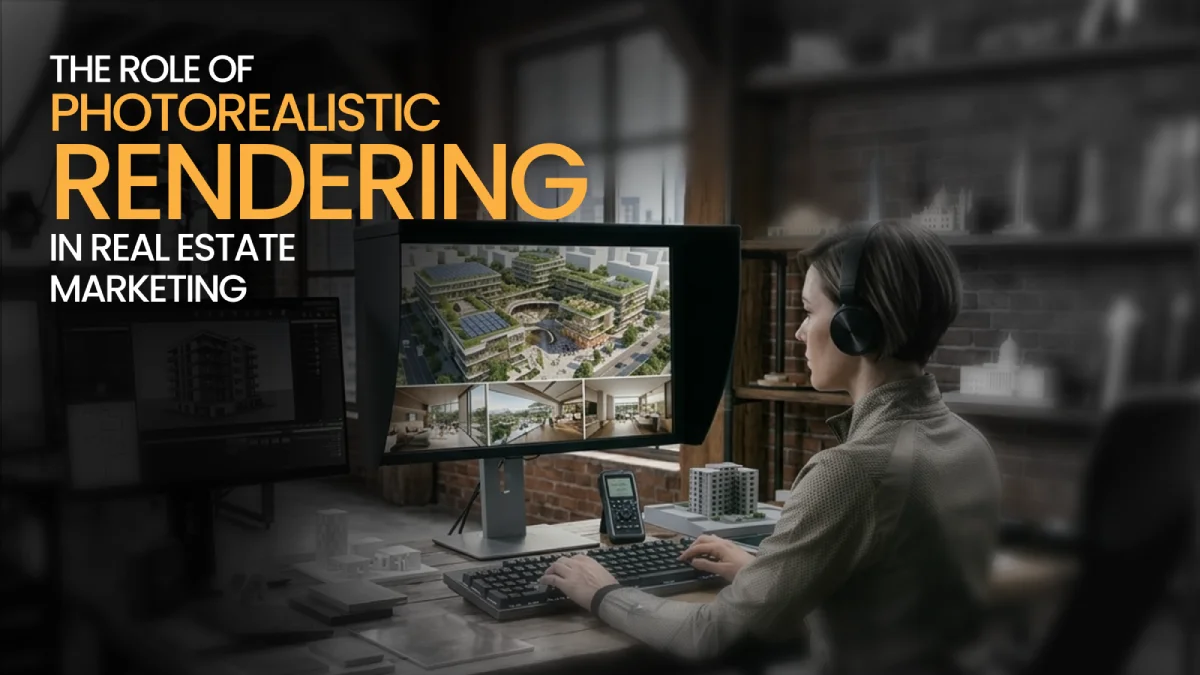
Real estate marketing has become a perfect example that how people are adapting with modern technologies and tools. Because, in today's generation, real estate marketing is no longer limited to traditional photos or physical visits to the property. Photorealistic rendering in real estate marketing is able to provide fast sales and high engagement.
This article will cover topics such as the importance of photorealistic rendering in real estate marketing, the technology behind it, how it improves buyer experience, and the complete picture of Cost vs. ROI and future trends in real estate visualization.
What is Photorealistic Rendering?
A simple definition of photorealistic rendering is creating 3D images. In a more technical sense, it is a way of creating an image that makes it appear as if a real-life image was taken. Professionals apply more advanced techniques in the areas of lighting, texturing, and shadows to create the best effect. The major goal is to make it work with everyday items by giving very realistic results. It employs a specific process that includes:
- Building a precise 3D representation of the object
- Emulating the effects of light using rendering software to determine how light interacts
- Incorporating realistic elements such as light and shadow, and texture, as well as natural illumination
- Finally, the digital 3D models are converted into images that are indistinguishable from real life.
Importance of Photorealistic Rendering in Real Estate Marketing
In marketing real estate, one of the biggest assets is photorealistic rendering because it generates a realistic image of a property in the mind of prospective buyers. To achieve this, you need professional photorealistic 3D rendering services that deliver high-quality visuals ready for use.
Using visual storytelling and accurate illustrations, real estate developers can depict a realistic representation of properties that are still in the planning and designing phases, or that have yet to be constructed and adorned. Here are some of the key advantages:
Creates Emotional Connection and Visualization
Establishing an emotional bond with buyers is one of the greatest benefits of photorealistic rendering.
Sometimes it's impossible to imagine the final rendered, furnished, and decorated visual look of the space based on a few sketches, a rudimentary blueprint, or a plain floor plan. Realistic renders aid in constructing a design and creating the furnishings to a degree that the client can understand the design.
Even though the building is not likely to be constructed soon, the realistic image will offer an understanding of the designed space for future customers, answering questions regarding the configuration, location of windows and doors, and the way people will circulate in the property.
Enhance Property Marketing
For a property marketing strategy to be successful in attracting prospective buyers, high-quality visual marketing is important. These images are a valuable part of the property marketing plan and can be used in:
- Marketing brochures
- Property Development websites
- Property Development Adverts
- Property Development Social Media Posts
Renders can highlight an idealized version of a home, featuring beautiful furnishings and rendered landscaping. Ultimately, this can spark interest and lead to increased inquiries from prospective buyers.
Helps Buyers in Decision-Making
In real estate, ultimate decisions usually come after countless seconds worth of thought. Photorealistic renderings help buyers to get a sense of what the developed property will look like, creating a visual of their property.
Also, there is a scope for buyers to have the freedom to choose their own preferences. This fosters confidence in their purchase and thus helps them make a decision more quickly.
Saves Time and Marketing Costs
Traditional real estate marketing relies heavily on physical site visits, which is time consuming and costly. Photorealistic marketing provides businesses with a 90% cost savings. Better yet, the ability to edit, cost decreases, and quality increases.
Improves Property Marketing Digitally
It is a fact that most property searches in this day and age start online. They prefer explore property listings before going for a physical visit to the property's.
Using walkthroughs to enhance site galleries, virtual tour experiences, social media marketing, and presentations. These tools provide the ability to explore a property, attracting a wider audience.
Highlights the Value and Detail
Photorealistic rendering showcased the architectural quality by designing the property with exceptional clarity. It displays the elements like premium materials, interior finishes, and lighting effects realistically.
Showcasing a construction's superior quality with attention to detail is essential when marketing the property. Buyers in this category are always concerned with the quality of materials and finishes used.
Technologies Behind Photorealistic Rendering
Photorealistic rendering relies on advanced technologies that enhance its realism, such as:
Ray Tracing and Path Tracing
Ray tracing simulates how light would travel through a scene and interact with surfaces, including reflections, shadows, and highlights. Path tracing can be thought of as a more advanced version of ray tracing.
In addition to simulating realistic shadows and reflections, path tracing can model the effects of light as a visible color emanating from surfaces, giving a scene more realistic illumination.
Realistic Materials (PBR)
In addition to realistic spatial (3D) simulation of materials, such as fabric, glass, wood, and metal, as well as the realistic simulation of fabric, metal, glass, and wood, Physically Based Rendering (PBR) technology aims to simulate the behavior of these materials when light is incident upon them.
Using fabric, glass, wood, and metal in the construction of materials can create the illusion of a three-dimensional appearance.
Lighting and Global Illumination
Global Illumination attempts to replicate how lights function in the real world, including how light reflects and scatters off the objects in the scene, such as the walls, floors, and the environment surrounding the scene. With HDR lighting, real-world lighting images are used, which provides a rendering with strong visual realism.
The Visual representation of real sunlight streaming through a window, or a cloudy day scene with soft lighting, appears very realistic.
Texture mapping and surface details
To provide color and other details to 3D objects, textures are utilized. The process of applying textures to a 3D model is referred to as UV mapping. UV mapping "captures" a 3D model surface in order to create a detailed surface appearance under a variety of lighting conditions.
Rendering Engines
Example rendering engines include V-Ray, Corona, Octane, and Unreal Engine. These are the software that processes and compiles the models, materials, and lights to create a final image. In a relatively short amount of time, these engines produce images and videos of high quality.
Post- Processing
After rendering, images are edited to improve their look. This usually includes:
- Modifying color, contrast, and brightness
- Adding a blur or halo effect to the center
- Adding fog or a haze effect
Processing aims to make the creation look as close to a real-life photo as possible.
Faster Rendering with GPUs
Graphics cards (GPUs) speed up rendering, as the computing power needed for rendering is much greater than that of a standard CPU. In large-scale projects, professionals use cloud rendering to drastically decrease the time needed to produce the images.
Real Time Rendering and VR
Virtual Reality (VR) is fully immersive, and 3D environments posed in real time can be explored as real. The Unreal Engine software, for example, allows for this kind of interactive 3D space and VR experience.
How Photorealistic Rendering Enhances Buyer Experience?
It is easy for buyers to visualize a space when multiple photorealistic renderings have been done on a property. Photorealistic rendering also brings the architectural plans down to real life. While building buyer confidence and improving their decision-making, this transparency also clarifies how the decision-making process works and influences their level of engagement.
Here's how photorealistic rendering enhances buyer experience:
Enables Personalization and Customization
Modern buyers are catered to with the use of customization capabilities so they can mirror and accommodate their lifestyle needs. With photorealistic rendering, developers can provide alternate designs for flooring, wall paint finishes, kitchen cabinet finishes, furniture arrangements, and lighting.
Some cutting-edge visual technology provides the opportunity for buyers to interact and customize design features during the visual experience so that they can assess the impact of design revisions in real time. When buyers interact with the design of their future home, it creates a feeling of anticipation and fulfillment.
Establishes Trust & Transparency
Trust is one of the most important components of real estate transactions. 3D rendering is the realistic experience and interaction with the rendering, rather than seeing and analyzing a series of photographs. This is why digital walkthroughs and virtual tours of properties are offered. 3D rendering encourages buyers to participate.
For remote buyers and investors, the walkthroughs can be particularly useful in cases where they cannot visit the site in person. In such cases, the use of virtual reality can help give the buyer a more engaging, relevant experience.
Photorealistic rendering showcases the developer's transparency and trust-building efforts to the buyer. This shows potential buyers what they would get if they purchased the property, based on what is in the architectural plans.
Enables Distance & International Buyers to Purchase
With each passing day, more buyers become international, purchasing properties in different cities or even countries. Such a situation implies that real estate transactions are becoming international. Prospective buyers are able to buy property from anywhere in the world.
Using photorealistic renderings, buyers are able to fully experience the property in different realities or even see it. Buyers can be located anywhere in the world and they are able to experience the property without the need for multiple visits to the other side of the country.
With the aid of virtual tours, photorealistic renderings, and aerial views, buyers can evaluate, analyze, and make educated decisions about a multitude of properties globally.
Shows the Property in Its Full Context
A property has more than just the interior; its exterior and surrounding area are just as important. Photorealistic renderings design the property and the surrounding neighborhood with streets, landscaping, and parks, as well as many other ecological aspects.
Street-level renderings and aerial views give buyers a better understanding of the property and its environmental relations, helping buyers understand the property and make educated decisions about the exterior and surroundings.
When buyers clearly understand their alternatives, their decisions are much easier.
Helps Buyers Compare Options Clearly
With many developments, buyers need to choose between various types of units, several layouts, or choose which floor they prefer. Photorealistic rendering of each option provides buyers with the best understanding of each choice, including the accurate lighting, views, and other spatial features.
This clarity helps buyers choose the option that best fits their preferences and way of life.
Improves Post-Purchase Satisfaction
Realistic visuals help buyers understand and manage the expectations regarding the development. When buyers undertake the purchase, they understand that the space will not be a surprise as they are expected to see the space as depicted in the renders.
Aligning expectations with reality will evoke a sense of satisfaction and will reduce buyer’s remorse and the chances of him/her disputing the purchase.
Photorealistic rendering allows buyers to improve and appreciate the overall experience and understand the development better. Adding rendering to interactive technology gives buyers the confidence and ease to undertake the purchase.
Cost vs. ROI: Is Photorealistic Rendering Worth It?
In a business’s marketing strategy, the expense of photorealistic rendering is justifiable given the long-term value it has the potential to provide. With an ever-changing world, it is important to keep pace with the changes that digital technologies and business models are undergoing.
- Less Risky Marketing: Abstract ideas are often difficult for customers to grab. Therefore, a text-only approach to marketing is less likely to be effective. Photorealistic marketing renders are a kind of marketing imagery that helps place potential buyers in a fully realized, envisioned building, helping customers envision the space and sell themselves.
- Increased Pre-Construction Sales: Developers can market and sell units of the development that are yet to be built. In the later phases of development, this practice is called pre-selling, and it allows for the earlier capture of revenue that can be reinvested in the development to finance successive stages of the construction.
- Reusable Marketing Assets: The same professional-quality render can be used as an asset in multiple marketing channels like brochures, websites, ads, portfolio and presentations. This versatility allows developers to maximize the value of a single rendering throughout the entire selling process.
- High ROI: The use of photorealistic rendering makes marketing for real estate projects more effective and increases the rate of sales. Considering what real estate gets in return from marketing and how quickly the sales process can be, the cost of photorealistic rendering is relatively low.
Future Trends in Real Estate Visualization
Real estate marketing is becoming more and more immersive and captivating. Augmented and virtual reality allow prospective clients to enter and navigate real estate situated in a fully digital world. Another emerging technology is AI rendering.
With the automation of lighting, textures, and scene optimization, designers are able to create renderings of higher quality in a more rapid and efficient manner.
Interactivity is an emerging trend that is going to influence how buyers interact with an environment. Buyers will be able to change the floor type, wall colors, move furniture, and see the changes in real time in a photorealistic environment.
Another emerging technology is the use of digital twins, which is being applied in real estate to satisfy the need for highly detailed visualizations in real estate promotions. Technology will advance marketers' ability to promote their products and increase buyers' ability to interact with the products.
Conclusion
To sum up, photorealistic rendering has become very useful tool for promoting real estate. It lets developers visualize the houses clearly even before construction is finished. These visualizations make it easier for potential purchasers to understand the layouts, materials, lighting, and overall design than standard blueprints or floor plans.
Photorealistic rendering not only makes things look better, but it also makes the buying experience better. It helps purchasers trust the process, lets them explore properties from afar, and lets them picture and even customize their future houses. It also helps developers sell their projects better, lower the risks of marketing, and get people interested earlier in the sales cycle.
Frequently Asked Questions
What is photorealistic rendering in real estate?
Photorealistic rendering is the process of creating highly realistic 3D images of properties using special software. These images look like real photos and help show how a new home or building will look after construction or renovation, and they can visualize that before it's done.
How does photorealistic rendering help sell properties faster?
Showing buyers, a realistic image of the finished property can help them understand the design better. Then they can visualize the space clearly, and they feel more confident in their buying decision.
How much does photorealistic rendering cost for real estate marketing?
Costs vary depending on complexity and quality. On average, a single rendering can range from $100 to $2,000 or more.
Can photorealistic rendering replace traditional real estate photography?
The answer is “Not completely”. Photography shows real properties, while photorealistic rendering is mainly used for properties that are still under construction or in the design phase.
What are the benefits of virtual staging compared to photorealistic rendering?
Virtual staging is cheaper and faster because it adds furniture to real photos of empty rooms. Photorealistic rendering is usually used when the property hasn’t been built yet.
How long does it take to create a photorealistic rendering of a property?
Most renderings take 1-7 days, depending on the level of detail and the number of revisions required.
Are photorealistic renderings effective for marketing under-construction properties?
Yes. They allow buyers to see what the finished property will look like, which helps developers attract interest and even secure early sales.
What future technologies will impact real estate rendering?
New technologies like virtual reality (VR), augmented reality (AR), AI-assisted rendering, and real-time visualization will make marketing properties more engaging and immersive.