

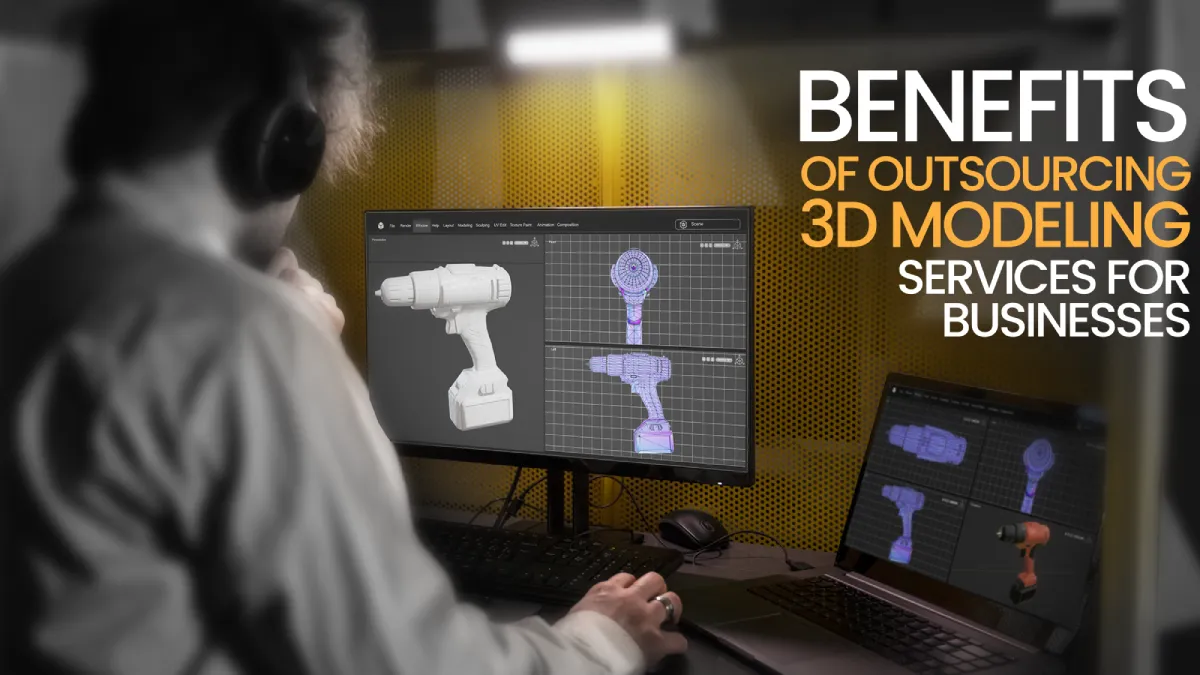
3D modeling has become a core part of how modern businesses operate, not just in obvious industries like gaming or architecture. It has now broadened across healthcare, retail, e-commerce, manufacturing, and beyond. The way companies communicate ideas, test designs, and create visual experiences has fundamentally shifted, and 3D assets are right in the middle of it.
But managing an in-house 3D modeling team is genuinely demanding. You need skilled artists, the right software, hardware that can actually handle the workload, and a team that stays current as tools and techniques continue to evolve. For many businesses, that kind of commitment simply isn't worth it, especially when project demand goes up and down, and you're not always sure what's coming next.
That's exactly why outsourcing has become such a go-to option. Instead of spending months hiring and training people, you just plug into a team that already knows what they're doing, has the right tools set up, and has handled enough different project types to hit the ground running. You get professional-quality work delivered without carrying the permanent overhead that comes with building that capability yourself.
Well, in this article, we will go through the real top 5 benefits of outsourcing 3D modeling services. We will also go through how different industries are actually putting 3D visualization to work, and cover what's worth paying attention to. We will also explain the necessary steps for you to figure out which outsourcing 3D partner is the right fit for your specific projects.
So, let's dig in.
What is 3D Modeling Outsourcing?
Before we dive into the deep sea of 3D modeling outsourcing, let's clear up what 3D modeling actually is.
In simple terms, 3D modeling is the three-dimensional digital representation of an object. It is an involved process of edges and polygons to shape a mesh. The main purpose of 3D modeling is to create a clear image of an object. Nowadays, these 3D models are usually used for various purposes, which include animation, games, product design, and architectural visualization.
3D modeling outsourcing is the process and practice of hiring a specialized team to create the 3D assets. This process includes real-life objects and concepts for applications. The 3D outsourcing process is simple:
- You reference images or sketches
- Send the files
- Explain the style guidelines, and
- Format the deadlines
This is where the main work gets started. An outsourcing team follows the requirements and creates the 3D models and necessary textures.
So, if we keep it simple, 3D Modeling Outsourcing is the whole outsourcing process from sending the requirements to getting the work done by an external team or individual people.
Top 5 Benefits of Outsourcing 3D Modeling Services
A recent study shows that the 3D models marketing is expanding and has created a huge demand across the globe. According to the market size, it is expected to reach USD 12.1 billion by 2035, growing at a CAGR of 18.95%.
Outsourcing 3D modeling not only saves time, but it also reduces a huge amount of money for a company.
Here are the top 5 benefits of outsourcing 3D modeling services:
Reduces Expenses
Building an internal 3D team adds up faster than most people expect. Salaries, high-end workstations, software licenses for tools like Autodesk Maya or 3ds Max, office space, and ongoing training. These costs stack on top of each other quickly and don't go away when projects slow down.
Outsourcing services lets you pay only for the work needed for a single model or full project without ongoing overhead. This approach saves 40-60% for many businesses, freeing budget for other priorities like growth or marketing. Small teams or startups get pro results without the full commitment.
Saves Times
Developing 3D models in-house takes weeks or more. It's the hassle of recruiting designers, training on tools like Blender, and building workflows from scratch.
On the other hand, outsourcing changes that. Companies like The KOW Company are there to change the game. We have teams, pipelines, and templates ready to go, so work starts right away and moves fast. A complex game asset that drags on internally gets done in days.
Access to the Specialized Experts
Different fields come with their own technical demands, like character sculpting in ZBrush, architectural drawings in Revit, and game asset optimization in Unity. These aren't skills you pick up quickly, and expecting one internal hire to cover all of it isn't realistic.
Outsourcing gives you direct access to people who've already worked through hundreds of projects like yours. They know what clean geometry looks like, how to handle textures properly,
Faster Turnaround
In-house, one designer often juggles modeling, UV mapping, texturing, and rendering, creating slowdowns. When you outsource, they use dedicated teams. They have an expert on modeling, another on texturing, and a third on lighting, often across time zones for near-constant progress. Projects with dozens or hundreds of assets wrap in 1-2 weeks instead of months.
Flexibility and Scalability
Workloads shift big pushes for assets one month, quiet the next. Outsourcing lets you scale up to many artists or down to nothing, without layoffs or idle pay. Options like hourly rates, per-asset pricing, or retainers match your needs, helping you adapt quickly to changes.
Industry-Specific Applications of 3D Modeling
3D modeling outsourcing helps industries without requiring large teams. It brings expert skills to life, saving time and money for real-world projects. It is hugely used in industries like:
- Architecture & Construction: Architects turn sketches into lifelike building walkthroughs by 3D modeling. It spots clashes early, like pipes hitting beams before costly fixes on-site. Expert outsourcing teams simulate city sunlight and wind to design smarter neighborhoods.
- Manufacturing & Products: In manufacturing and product design, 3D modeling lets companies work through ideas and catch problems long before anything gets built in the real world. Rather than going straight to physical prototypes, which cost money and take time to produce, designers build a digital version first. They test product shapes digitally by slashing waste on prototypes.
- Healthcare: 3D modeling in healthcare is impacting a lot in peoples lifes. Now, doctors can rehearse surgeries on patient-specific heart or bone models before the actual surgery. It can help them to understand the patient's anatomy and reduce the potential risks.
- Gaming & Entertainment: 3D modeling plays a major role in the gaming industry. Studios use it to quickly create detailed characters, environments, props, and visual effects that bring digital worlds to life. Instead of building everything from scratch internally, many companies outsource parts of the work to speed up their production.
- Retail & E-Commerce: In retail and e-commerce, Brands create interactive 360-degree product models that let customers rotate, zoom, and visualize items in context, surpassing static images for more informed purchasing decisions. This reduces return rates and elevates the online shopping experience through accessible, high-engagement visuals.
- Fashion: Fashion is one of those industries where 3D modeling snuck in and changed everything before most people noticed. Designers can play around with fabrics, textures, and how something actually fits on a virtual mannequin, watching how a dress drapes or how a jacket moves without cutting a single piece of fabric first.
- Automotive & Aerospace: In the automotive and aerospace industries, 3D modeling helps engineers design. They get to test the complex mechanical systems before manufacturing begins. Using the necessary engineering software, professionals can build precise digital models of vehicles, aircraft components, and mechanical assemblies.
How to Choose the Right 3D Modeling Partner?
Finding the right 3D modeling partner is one of those decisions that quietly shapes how your entire project turns out. Get it right and everything clicks. Get it wrong, and you're dealing with missed deadlines, rework, and a lot of unnecessary stress.
There's no perfect checklist, but working through a few key things before you commit can save you a lot of headaches down the road.
Step 1: Define Your Project Needs
A lot of people jump straight into browsing portfolios without actually nailing down what they need first. This approach eventually leads to a lot of consequences later. So, before you reach out to anyone, take some time to get genuinely specific about your project requirements.
Think about the type of models involved. Game characters, architecture models, product visuals, and mechanical parts each one carries its own technical weight. A studio that excels at stylized game assets may be completely out of its depth with a precision engineering model, and vice versa.
From there, consider the level of detail your project demands, the file formats your workflow depends on, like OBJ, FBX, or STL, and whether any specific software is involved, such as Blender, Maya, or Revit. When you walk into that first conversation with clarity, it becomes a lot easier to figure out quickly whether someone is genuinely the right fit or just telling you what you want to hear.
Step 2: Review Their Portfolio
Give it real time, not just a quick scroll. A portfolio is about as honest as it gets because it shows actual work that was delivered for better client satisfaction.
Pay attention to all the technical details. Ask the common questions, like is the geometry clean and well-structured? Do the textures hold up when you look closely? Is the lighting doing its job, or does everything feel flat? These things tell you far more than a flashy homepage ever will.
If you spot work that genuinely resembles your project, take that seriously. It means they've already dealt with the specific challenges your type of work brings. They're not learning the hard way on your project and your budget.
Step 3: Evaluate Industry Expertise
This one tends to get overlooked, but it matters more than most people realize. 3D modeling looks like one skill from the outside, but the technical demands shift considerably depending on the industry.
Game development studios need artists who understand real-time optimization and engine pipelines. Architectural projects call for someone comfortable with BIM tools and accurate measurements. Product designing services has its own set of standards entirely. When a partner has genuine experience in your space, it shows up in small but important ways in the questions they ask, the assumptions they don't make, and the standards they naturally work toward.
Step 4: Check Communication and Support
Poor communication has derailed more projects than poor technical skill ever has. You need someone who responds without you having to follow up twice, asks the right questions before jumping in, and keeps you informed without you having to dig for updates.
Plenty of good teams use simple project management tools to keep things visible and organized. Nothing complicated, just something that shows you where things stand at any given moment. If a potential partner is already vague or slow during your first few exchanges, don't expect that to improve once the work actually starts.
Step 5: Compare Pricing and Turnaround Time
Cost matters, but treating it as the main factor usually backfires. The lowest quote often ends up being the priciest option by the time you account for redos, delays, and the time you personally spend managing problems that shouldn't exist.
Ask for a detailed quote that clearly breaks down what's included, how revisions are handled, what formats you'll receive, and what the actual timeline looks like. Then compare a few providers on the full picture, not just the number. Someone who charges a bit more but consistently delivers solid work on time is worth it almost every single time.
Step 6: Start with a Small Test Project
Even if everything looks promising, don't go all in right away. Start with a small work, like a single model, one scene, a basic asset, something that gives you a real feel for how they operate without putting a major project at risk.
That first small job will tell you how they read a brief, how they respond to feedback, whether they hit their own deadlines, and whether what gets delivered actually matches what was discussed. If it goes well, you move forward with real confidence. If something feels off, you found out early enough to do something about it, and that's exactly why you did it this way.
Implementation Best Practices of Outsourcing 3D Modeling Services
If you want outsourced 3D modeling to actually work well for your business, the groundwork you lay at the start matters more than most people think. Before anything else, get your project requirements written down in real detail, like:
- What kind of models do you need?
- How much detail is involved?
- What file formats work with your pipeline?
- Which software needs to be compatible?
Handing a modeling team vague instructions and hoping for the best is a reliable way to burn through revision rounds unnecessarily.
Try to stay involved once the work starts. Not in a micromanaging way, but enough to catch problems early. Regular check-ins and honest feedback sessions make a real difference in whether a project lands where it should. Most decent teams already have some kind of project management setup in place, so use it rather than relying on long email threads.
If you haven't worked with a particular team before, don't throw a major project at them straight away. Keep your documentation in order. Track your assets, note what changed in each revision, and keep delivery records organized. It sounds boring, but it saves a surprising amount of time when things get busy.
Future Trends and Opportunities of 3D Modeling
3D modeling is quietly working its way into more corners of business than most people realize, and that trajectory isn't changing anytime soon. The global 3D modeling market is projected to reach $15B+ by 2030, driven by increasing demand for efficient design solutions.
AR and VR are probably the biggest drivers right now. Gaming, retail, education, and corporate training are all of these spaces that are leaning harder into immersive experiences, and quality 3D assets are what make those experiences actually work. The demand coming from that direction alone is substantial. The VR market alone is projected to reach $382.87 billion by 2033.
E-commerce is another area worth paying attention to. Customers shopping online can't pick something up and turn it over in their hands, but interactive 3D product models get pretty close. Stores using them are seeing better engagement and stronger conversion numbers, which means more businesses will be looking for this capability going forward. Virtual prototyping will replace 80% of physical prototypes by 2028, changing how businesses validate and iterate on designs.
Gaming and entertainment will keep pushing what's technically possible; that's always been true and won't change. Architecture and real estate are also using 3D visualization in ways that have become genuinely useful rather than just impressive, particularly when presenting unbuilt projects to clients who struggle to read technical drawings. The gaming industry alone is projected to reach nearly $300 billion by 2029, with 3D gaming technology growing at 15.81% annually through 2035.
Conclusion
3D modeling outsourcing has become a practical and strategic solution for businesses that want high-quality digital assets without building a full in-house team. From reducing operational costs to speeding up production and gaining access to specialized experts, outsourcing allows companies to stay efficient and competitive in a fast-growing digital market.
The industries using it are all over the map now. Architecture, gaming, healthcare, retail, fashion, automotive, the common thread is that 3D modeling helps teams visualize ideas and present work in ways that simply weren't on the table before. When you're working with the right partner, scaling up, hitting tight deadlines, and keeping quality consistent becomes a lot more manageable without burning out your internal people.
AR, VR, and interactive e-commerce aren't future concepts anymore; they're already changing how customers experience products and how businesses present their work.
Businesses that start building reliable outsourcing partnerships now won't be scrambling to catch up later. At the end of the day, outsourcing 3D modeling company isn't really about trimming costs or saving a few hours. When you outsource services from professionals like The KOW Company, you give your business room to be more creative, move faster, and stay relevant in a market that's evolving. Send us your project for a test to see what we can do. Ready to begin? Contact us at [email protected] or visit our contact page to discuss your project needs.
Frequently Asked Questions
What types of 3D modeling services can be outsourced?
You can get plenty of 3D modeling services by outsourcing. This includes product modeling, architectural visualization, character modeling, game assets, engineering models, and 3D rendering.
What industries benefit the most from outsourcing 3D modeling services?
Architecture, real estate, gaming, e-commerce, manufacturing, and entertainment get the most value out of it, mainly because their workloads are high and the need for specialized skills is constant.
Can outsourcing 3D modeling services help scale my business operations?
Yes. Outsourcing 3D modeling from a professional like The KOW Company, you take on bigger workloads and deliver faster without the cost and time of building an in-house team.
How do I choose the right 3D modeling outsourcing services provider?
To choose the right 3D modeling outsourcing, you need to look at their portfolio, check their industry experience, pay attention to how they communicate, and make sure their pricing and timelines are clear and realistic.
What is the difference between outsourcing to a 3D modeling company and hiring freelancers?
A company gives you a full team and a structured process. A freelancer works solo, which is fine for smaller jobs but can become limiting on larger or more complex projects.
What are the main advantages of outsourcing 3D modeling services for businesses?
The main advantages of outsourcing are lower costs, access to skilled professionals, and the flexibility to scale projects up or down without long-term commitments.
How long does it typically take to complete outsourced 3D modeling projects?
Simple models can be done in a few days. Complex projects with high detail or multiple assets can take several weeks. Scope is really what drives the timeline.
What is the cost of 3D modeling services?
Costs vary depending on project complexity and the level of detail, but a custom 3D modeling service ensures you get models tailored to your exact needs.