

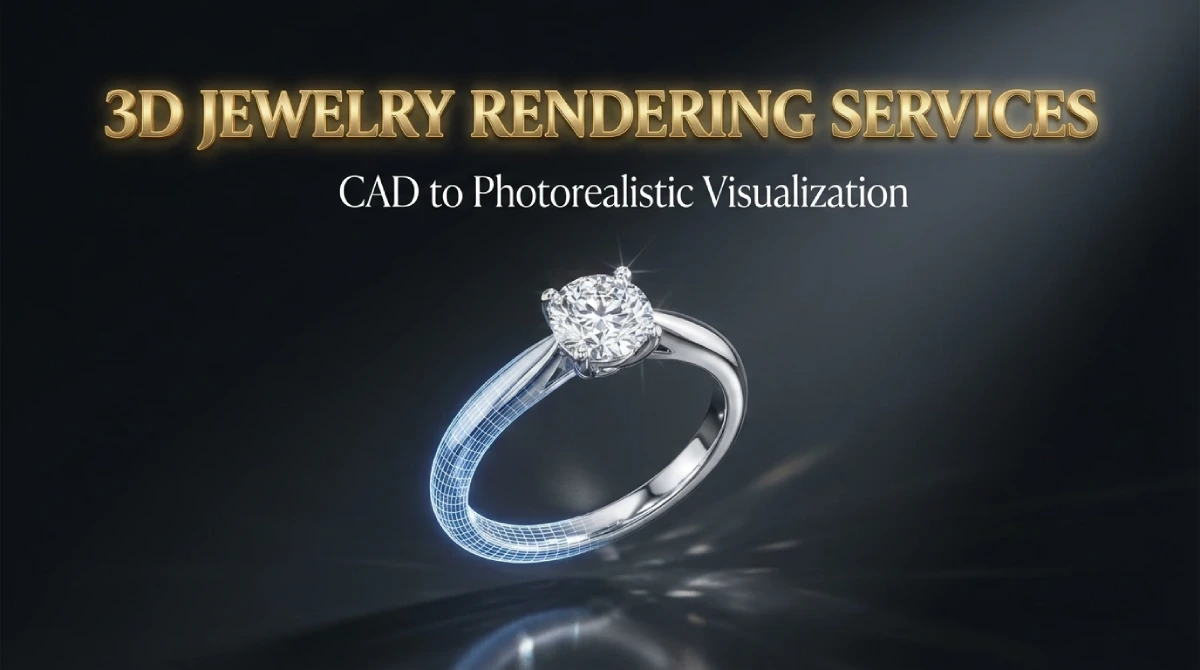
In 2026, 3D jewelry rendering is more than a visualization tool; it’s an AI-powered design ecosystem. From real-time rendering to automated CAD generation and virtual try-ons, the technology is transforming how jewelry is designed, presented, and sold.
With the help of AI and cloud-based workflows, designers and manufacturers can now collaborate more efficiently. They can work together simultaneously and share updates right away. These tools also help simulate materials with exceptional realism, making designs look very close to real products. Designers can also iterate faster and test multiple ideas in less time.
In this article, we will explain 3D jewelry rendering services, covering the workflow from CAD to photorealistic output, along with pricing, AI trends, and choosing the right provider. It shows how it helps save time, cut costs, and improve quality.
What Is 3D Jewelry Rendering?
3D jewelry rendering is basically the process that is used to create highly realistic digital images or the animation of jewelry. By using specialized 3D computer software, professionals create and transform a digital 3D model into a lifelike visual. They focus on creating representations that simulate real-world materials like gold, platinum, silver, diamonds, and other gemstones with the proper lighting, reflection, and texture.
In simple terms, 3D jewelry rendering lets designers, producers, and marketers virtually showcase jewelry designs in any phase of production, as opposed to traditional photography that necessitates a final physical object.
3D Rendering vs Traditional Jewelry Photography
| Feature | 3D Jewelry Rendering | Traditional Jewelry Photography |
| Method | Created digitally using 3D software's | Usually, photos are taken with real jewelry and a camera |
| Product Needs | No physical product required | Physical jewelry required |
| Speed | Fast and easy to update | Slower due to setup and reshoots |
| Cost | Cost-effective in the long term | Higher cost with studio, equipment, and retakes |
| Flexibility | Easy to design the metal or stone | Difficult to adjust changes after shooting |
| Lighting | Fully controlled in software | Depends on the real studio lighting |
| Consistency | Same style on all images | Can vary between photos because of the lighting and other requirements |
| Realism | Very realistic but computer-generated | 100% real product photos |
Why Brands Are Switching to 3D Jewelry Rendering?
Brands are increasingly adopting 3D jewelry rendering to reduce production costs. The global market was worth $93.2 million in 2025. It is expected to grow to $366.3 million by 2033, at a 19% annual rate. 3D product visualization can reduce product returns by up to 40%.
Beyond cost savings, this shift also speeds up time-to-market and enables the creation of highly realistic, versatile marketing visuals. Eventually it:
- Creates visuals before manufacturing and reduces time to market
- Reduces the need for repeated prototypes or expensive photoshoots
- Quickly updates the metals, stone, or designs without reshooting
- Creates clean, consistent, and premium marketing images
- Let buyers experience different variations before purchasing a product
- Marketing can start before the production
- Uniform lighting, style, and backgrounds across all products
- Easily create large catalogs without extra production effort
- Brands using 3D rendering report 30% faster time-to-market
How 3D Jewelry Rendering Works - The Full Process
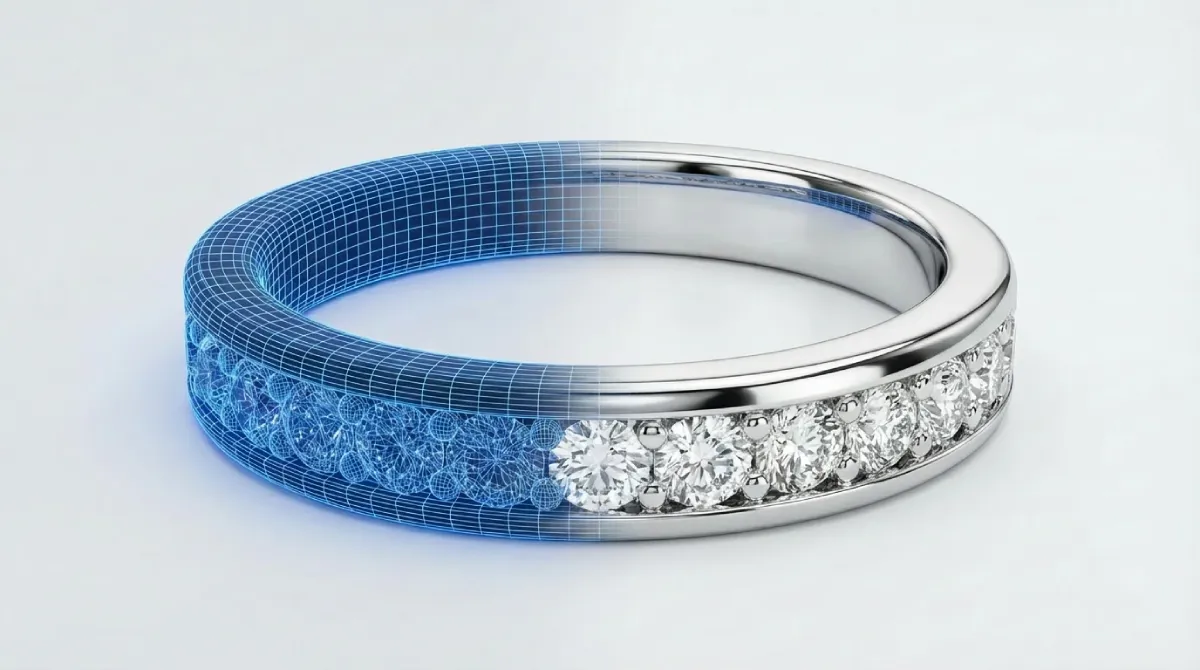
Basically, 3D rendering is the process of converting CAD (Computer Aided Design) designs or sketches. It converts photorealistic 2D images or animations by using advanced 3D software.
Here's the full process of 3D jewelry rendering:
Step 1 - CAD File Preparation or Sketch Input
The jewelry process starts with a proper concept. It can be a hand-drawn sketch, reference image, or existing CAD (Computer Aided Design) file. Then, the next step includes the shape, proportions, and gemstone placement.
When the CAD file is provided, it is usually reviewed and optimized to ensure it is clean and accurate. It's the foundation for the entire process for aligning the visual direction with technical requirements.
CAD file preparation and sketch input involve converting hand-drawn sketches or conceptual ideas into 3D ideas.
Step 2 - 3D Model Building
After CAD file optimization, professionals move on to creating a detailed jewelry model using specialized CAD software. They refine the design with tools like Rhino 3D, MatrixGold, Autodesk Revit, and ArchiCAD.
Key elements like prongs, settings, curves, and gemstones are carefully constructed to match real-world dimensions. The model is developed with manufacturing in mind, ensuring it is accurate, practical, and ready for production.
Step 3 - Material & Gemstone Application
At this stage, realistic materials are applied to the 3D model to make it look like real jewelry. Metals and gemstones are given properties that control how they reflect and interact with light.
- Metal textures (gold, silver, platinum): Metals are assigned finishes like gold, silver, or platinum with settings for shine, reflection, and surface type (polished, matte, or brushed).
- Gemstone refraction, brilliance, scintillation: Gemstones are adjusted to control how light passes through and reflects inside them, creating brightness, sparkle, and realistic shine.
Step 4 - Lighting Setup & Environment
In the next step, a virtual studio environment is usually created to replicate the real-world photography conditions. Designers use the HDRI maps and studio lighting setups to control the reflections, highlights, and shadows on the jewelry surface.
The camera's focal length, depth of field, and angle of view are all tweaked to make it look like a professional macro shot. Lighting has a crucial role in improving the visual quality of the finished product by bringing out the sparkle of metals and gemstones.
Step 5 - Rendering & Post-processing
Rendering engines, like KeyShot or V-Ray, simulate the interaction of light with all materials in the scene before processing it. To create photorealistic shadows, reflections, and refractions, methods like ray tracing are employed.
Color correction, contrast enhancement, and background refinement are some of the post-processing operations performed on the rendered image in editing software. The main goal of rendering and post-processing is to produce a final product that looks polished and ready for marketing.
Step 6 - Final Delivery & File Formats
In the final stage, the complete visuals are exported in suitable formats for their intended use. High-resolution JPEG or PNG files are generally used for e-commerce platforms, while TIFF files are commonly used for print production.
Animations are usually delivered in MP4 or GIF formats for interactive presentations. This ensures the jewelry is optimized for marketing and production workflows.
Types of 3D Jewelry Rendering Services
3D jewelry rendering services are designed mainly to create different types of visuals based on business needs. Each service focuses on unique output formats.
Here are some of the top 3D jewelry rendering services that are in demand on the market:
Photorealistic Still Image Rendering
This service can make static, high-resolution images that replicate the appearance of actual jewelry photos. The lighting, reflections, and textures of metals and gemstones are carefully rendered. The majority of the time, these renders are made from various perspectives on neutral or white backdrops.
Best for: E-commerce, product catalogs, and client previews.
360° Interactive Jewelry Rendering
360° interactive jewelry service lets customers appreciate the jewelry's finger points. It includes the sparkle, the setting, or proportions by assessing the jewelry virtually. It lets the customers view any angle through an interactive viewer or turntable animation.
Best for: Online stores and customer engagement.
3D Jewelry Animation & Video Rendering
Animation rendering captures the integral elements of an aesthetic presentation, such as the dance of the light on the stones and the metal. An animation rendering presentation can be continuously engaging.
Best for: social media, advertisements, and promotional campaigns.
On-Body / Lifestyle Rendering (Virtual Try-on)
This focuses on positioning the jewelry on the model's hand, neck, ear, or in a stylized setting for an ambient application. Supplemental AR can be used for the user-activated engagement of virtually trying the jewelry on the user.
Best for: marketing, branding, and enhancing customer buying confidence.
CAD Rendering for Pre-Production
CAD rendering focuses on creating precise, production-ready visuals from 3D models. By using 3D models created in programs like Rhino 3D or MatrixGold, CAD aims to produce accurate, production-ready images.
Before production begins, designers can use these renderings to assess the product's size, structure, and technical aspects. It works well for planning production, creating prototypes, and validating designs.
Best for: design validation, prototyping, and production planning.
3D Jewelry Rendering Pricing - What Does It Really Cost in 2026?
In 2026, 3D jewelry rendering prices vary mostly based on design complexity. Here's the full overview of what actually costs:
| Service Type | Features | Best For | Price |
| Basic Jewelry Render | Simple design, white background, basic lighting | Bulk e-commerce, low-cost projects | $20 – $50 / image |
| Standard Jewelry Render | Better materials, reflections, moderate detail | Online stores, product listings | $50 – $150 / image |
| High End Render | Advanced lighting, gemstone sparkle, premium realism | Marketing, premium brands | $150 – $400+ / image |
| CAD + Rendering Bundle | Model creation + final images | Custom jewelry projects | $80 – $1,200+ / product |
In-House vs Outsourcing 3D Jewelry Rendering
For jewelry brands, deciding whether to do production in-house or outsource is a big choice that has a direct impact on cost, quality, and speed.
In-house Rendering of 3D Jewelry
- Pros: Full control over the quality of the designs, a uniform brand style, and the ability for designers and rendering artists to work together in real time. Since all work remains within the corporation, it also provides better security for intellectual property.
- Cons: Exorbitant overhead for things like staff pay, software, hardware, and employee education. It also needs to keep track of skilled workers and may have extra work during busy times.
- Best For: Large jewelry brands that produce items continuously. They follow strict quality standards and work with highly confidential, proprietary designs that require full in-house control.
Outsourcing 3D Rendering Services for Jewelry
- Pros: Easy scalability for big or seasonal projects, lower total costs, and access to a highly specialized global workforce. Quicker turnaround times without committing to long-term hiring are also made possible.
- Cons: Quality may vary from provider to provider. Minor concerns about data security or consistency.
- Best for: Startup, a small to medium jewelry brand, or a big business that needs scalable production with professional results but doesn't want to invest in in-house infrastructure.
Quick comparison table between In-house Rendering vs. Outsourcing:
| Features | In-house Rendering | Outsourcing Rendering |
| Costs | Higher fixed costs (salaries, hardware) | Flexible costs (pay per project) |
| Control | Full control over the process | Moderate control (depends on communication) |
| Speed | Depends on team capacity | Faster turnaround with scalable resources |
| Expertise | Broad, general skill set | Access to highly specialized professionals |
| Security | Managed internally | Relies on trust (NDAs often required) |
AI in 3D Jewelry Rendering - 2026 Trends
AI has been continuously transforming 3D jewelry rendering in 2026. It's making the workflows faster, smarter, and more accessible. It's automating the repetitive tasks and helping professionals focus on the quality and emotion.
- AI Design Generation: By using tools like MatrixGold and Rhino 3D, designers can generate 3D jewelry from sketches, texts, or images. This saves time in initial conceptualization and allows for rapid production of several design iterations.
- Rendering and Automation: AI-powered denoising, auto-lighting, and scene setup reduce manual work. It produces a decrease in the cost of production work for many work streams.
- Real-time and neutral rendering: Technologies such as NeRF and Gaussian splatting (3DGS) are able to make photorealistic images and videos with less computing power. This means they can also reduce rendering times.
- Personalization: Customers are able to customize various options in jewelry (type of metal, the stones that are included, and the style). They can see an updated 3D view in real-time of the selection, which increases confidence in the purchase.
- Virtual Try-on and AR: AI enables users to see a virtual representation of themselves wearing the jewelry on the hand, neck, or ear. It increases confidence in the purchase and gets rid of the need to return the purchase after the item has been bought.
- Design Innovation: AI assists in the design processes, enabling the production of complex and intricate designs that are very difficult to achieve without AI tools.
How to Choose the Right 3D Jewelry Rendering Service?
Choosing the right 3D jewelry rendering services requires careful review of several factors. You should prioritize experience in jewelry, review their portfolios, and evaluate the turnaround times.
Here is a step-by-step process that can be helpful for choosing the right 3D rendering service:
- Define your goal clearly: Defining your goal with intention. Clarify if it's for e-commerce, marketing, client approvals, or productions. Classification of the niche helps to give the provider a clear vision. Because each goal has its own requirements, like the budget, styling, and realism.
- Evaluate portfolio realism in detail: Analyze the realism of the portfolios. Look for portions of the work where there was realism with metal, gemstones, and other fine details. Consider how the diamonds and metals were rendered or how they reflected and interacted with the light. It’ll give you a clear vision of their work.
- Choose jewelry-specific expertise: Choose expertise specific to jewelry. Not just anyone can do jewelry renders, and good providers know what to do with the stones, balance, and the settings, and how metals are combined. This is what sets a good provider apart from an average one.
- Compare pricing, revisions, and scalability: Before making any decisions, consider the prices and the amount of work. Don’t just look for the lower price. Look at included services like the number of viewed renders, the number of revisions, and how consistent the work is. If you have a lot of products, check for bulk discounts of up to 10% to 30% savings, and make sure they can accommodate your volume.
- Test communication and workflow with a trial: Starting with a single trial is better than doing the entire batch. This allows you to assess communication, turnaround time, and how revisions are handled. An efficient workflow is as important as the quality of the visuals.
Final Thoughts
3D jewelry rendering has transformed the jewelry industry by replacing traditional photography with fast, flexible, and highly realistic digital visuals. It allows brands to design, visualize, and market jewelry before physical production, saving both time and cost while improving creative control.
Advancements in AI, real-time rendering, and augmented reality (AR) have made the workflow more efficient and easier to use. From CAD modeling to final marketing visuals, it now supports the entire jewelry workflow.
In 2026, 3D jewelry rendering is not just a design tool; it is an essential part of modern jewelry branding, sales, and customer experience.
Frequently Asked Questions
What is 3D jewelry rendering?
3D jewelry rendering is the process of creating realistic digital images or animations from 3D jewelry models. It simulates metals, gemstones, lighting, and reflections to produce photorealistic visuals before manufacturing.
How much does a 3D jewelry rendering cost?
The cost of 3D jewelry rendering per image depends on quality. Basic renders cost around $20-$50, standard quality ranges from $50-$150, and high-end or luxury renders can go from $150-$400+ per image, depending on complexity and realism.
What software is used for jewelry 3D rendering?
Commonly used tools for jewelry 3D rendering are Rhino 3D, MatrixGold, Blender, KeyShot, and V-Ray.
Do I need a CAD file to get a 3D jewelry render?
Yes. Using an existing CAD file can save both time and cost. If they don't have one, the provider can make one using your ideas or their own (though it will likely cost more).
How long does a 3D jewelry render take?
It only takes a few hours to render something in 3D, but detailed or high-end projects can take a few days, based on the level of detail and changes needed.
What is the difference between 3D rendering and jewelry photography?
Digital 3D rendering reduces the need for actual jewelry, in contrast to photography, which necessitates the final product. Lighting, materials, and design changes can be more easily adjusted using rendering.
Can 3D jewelry renders be used for e-commerce listings?
Yes. Due to their consistent, high-quality, and scalable product graphics, they are frequently used by online businesses.
How realistic are 3D jewelry renderings?
Real pictures and high-quality renders are often hard to tell apart, especially when advanced lighting, material simulation, and ray tracing are used.
Can I see different metal and gemstone options in the same rendering?
Yes. You don't need to start from scratch; you can just add new gemstones, reshoot, or use silver, gold, or platinum.
Is my jewelry design safe when outsourcing rendering services?
Trustworthy studios protect your designs with non-disclosure agreements and secure processes. Before beginning, make sure to confirm any policies about confidentiality.
Will AI replace traditional 3D jewelry rendering?
No. The truth is that human designers are still required for accuracy, originality, and quality control in the end, even though AI will make the process faster and easier.
Can The KOW company do 3D jewelry rendering?
Yes, The KOW Company offers professional 3D jewelry rendering services. They can create photorealistic visuals of jewelry designs, including metals, gemstones, and lighting effects, to help clients preview their products before manufacturing. You can also send test work free of charge, making it easier to share your ideas and see how they can be transformed into high-quality renders.